SEO Competitor Analysis
Your competitors are already ranking for keywords you want to own. They’re earning backlinks while you’re building them from scratch. They understand their audience in ways you haven’t discovered yet.
The difference? They’ve likely conducted professional SEO competitor analysis. You can too.
At Techpullers, as an SEO company in Kerala with eight years of experience, we’ve analyzed competitor strategies for over 100 clients across industries. We don’t pull surface-level metrics. We dig into their entire SEO infrastructure — keyword gaps, backlink sources, top-performing content, technical stack, and everything driving their rankings.
This intelligence becomes your roadmap.
Get Your Free Competitor AnalysisSEO competitor analysis is the systematic process of researching and analyzing your competitors’ search engine optimization strategies to identify opportunities, threats, and gaps in your own approach.
It’s not about copying what they do. It’s about understanding what’s working in your competitive space and finding the angles they’ve missed.
A proper competitive SEO analysis reveals which keywords your competitors rank for and how much traffic they earn, where they’re building backlinks and why those links matter, what content performs best for them, their technical SEO strengths and weaknesses, and content topics they haven’t covered yet.
You’re investing in SEO already — whether through an agency, in-house campaigns, or both. Without seo competitor research, you’re making that investment half-blind.
Your competitors have spent months or years building SEO authority. They know which keywords convert. They’ve tested content types. They’ve built relationships with link sources.
You don’t have the luxury of trial and error at that scale. Professional competitor research compresses that timeline. Instead of testing 20 keyword angles, you test the five your competitors are already ranking for — plus the gaps they’ve left open.
Competitor keyword analysis reveals search terms you should be targeting but haven’t considered. These aren’t obscure, low-volume keywords. They’re often medium-volume, high-intent terms that your competitors own but that your target audience is actively searching for.
We use advanced Google search techniques combined with Ahrefs data to uncover these opportunities at scale — finding terms that standard keyword research tools miss.
Link building is expensive. Competitor backlink analysis shows you where your competitors are earning links — industry directories, resource pages, news sites, academic institutions, guest posting opportunities.
More importantly, it shows you why those links matter. Are they high-authority links? Do they come from relevant domains? Without this intel, you’re building backlinks based on guesswork. With it, you’re targeting the same sources already driving authority for your competitors.
You may be creating good content. But is it addressing the topics your audience actually searches for? And are you covering angles your competitors are ignoring?
Content gap analysis shows you which topics your competitors have published on, how deep their coverage is, and which related topics they haven’t touched yet. This is where your differentiation lives.
We map your competitors’ entire backlink structure — not just the number of links, but their quality, source diversity, and anchor text distribution.
This includes overall domain authority metrics (Domain Rating and authority scores), backlink count and quality distribution, link source diversity, anchor text analysis (which keywords they’re building authority for), and recent link activity.
A competitor with 500 backlinks from low-authority blogs isn’t as strong as one with 100 links from industry-leading domains. Understanding the difference changes your entire link strategy.
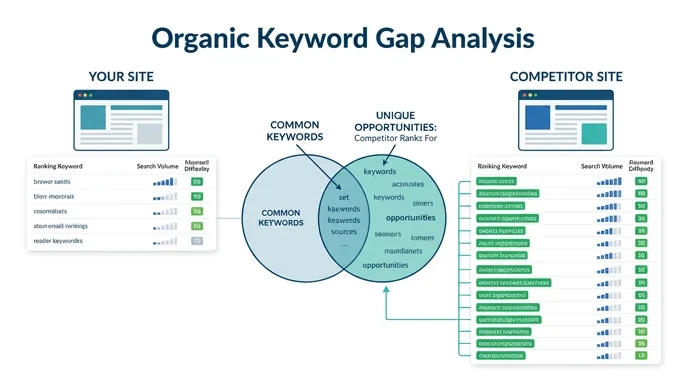
This is where the real actionable insights live. We identify keywords your competitors rank for that you don’t — and categorize them by opportunity level.
We look for high-opportunity keywords (medium-to-high volume, lower competition, relevant to your business), content gaps, ranking position analysis (positions 1–3 vs. 4–10), traffic distribution, and long-tail variations that often convert better than head terms.
This competitor keyword analysis typically reveals 20–40 keyword opportunities you hadn’t identified through standard keyword research alone.
Your competitors have published hundreds of content pieces. We analyze which topics they’ve covered, how deeply, and — critically — which topics your audience searches for that they’ve overlooked.
This includes topic clustering, content depth analysis, content format mix, update frequency, and missing topics where you can own the conversation.
Not all pages drive equal traffic. We identify which pages concentrate your competitors’ organic traffic and why those pages perform.
This reveals their top-performing pages by estimated organic traffic, traffic distribution patterns, page structure elements, and conversion-focused pages designed to drive leads or sales.
We map where your competitors earn links. Guest posting? Industry publications? Resource pages? Thought leadership citations?
This shows primary link sources, link-earning content types, anchor text patterns, and realistic link targets you can pursue without needing their authority level.
Rankings depend on both authority and technical health. We assess competitors’ technical SEO maturity: site speed, Core Web Vitals, mobile-friendliness, indexation health, schema markup, internal linking structure, and sitemap optimization. Technical gaps are often easier to close than authority gaps. Our SEO audit services cover technical assessment in depth.
We identify your true competitors — not just the obvious ones. True competitors are ranking for your target keywords, not necessarily offering identical services. We typically analyze 3–5 primary competitors and 2–3 secondary competitors.
Using Ahrefs Site Explorer, we pull complete data on each competitor: full backlink profiles, all organic keywords, traffic estimates, content performance metrics, anchor text distribution, and link source breakdown. We also use the Content Gap tool to identify opportunity overlaps.
We map your position against competitors across four dimensions: keyword gap (keywords they rank for, you don’t), backlink gap (their link sources vs. yours), content gap (topics they’ve covered, you haven’t), and traffic gap (estimated organic traffic comparison).
Not all gaps matter equally. We score opportunities by relevance, accessibility (can you rank in 3–6 months?), impact (traffic/revenue potential), and competitiveness. This focuses your effort on high-ROI opportunities first.
The final deliverable isn’t a data dump. It’s a prioritized roadmap showing exactly which content to create, where to build backlinks, and which technical improvements matter most.
your current competitive position, top three opportunities ranked by impact, key findings and strategic recommendations.
detailed spreadsheet of competitor keywords you’re missing, with search volume, keyword difficulty, estimated traffic, opportunity scoring, and priority order.
sites linking to competitors but not you, with domain authority, relevance scores, link type categorization, and outreach templates.
competitor topics organized by cluster, content type breakdown, gaps where you can establish authority, and recommended content pieces.
how your technical SEO compares to competitors, quick wins, and longer-term improvements.
visual overview of your position vs. competitors, market share estimates by keyword cluster, and seasonal trends.
Competitor analysis isn’t a one-time report. It’s the foundation of every smart SEO strategy.
It defines your SEO priorities by eliminating guesswork — showing which keywords are worth the effort, which content gaps represent real opportunities, and which technical improvements move the needle most. It informs your keyword strategy by revealing terms competitors haven’t captured. It guides content creation toward filling gaps rather than competing on saturated topics. It accelerates link building by targeting sources already linking to competitors. And it enables continuous improvement through regular re-analysis.
We recommend re-running competitive SEO analysis every 6–12 months to stay ahead of evolving competition.
Many agencies deliver competitor reports. We use competitor data to build your strategy. Every recommendation comes with context: why we’re recommending it, what to expect, and how it fits your broader SEO goals.
Every analysis uses Ahrefs enterprise data combined with eight years of consulting experience. We understand which metrics predict rankings and which are vanity numbers.
A 100-page report full of competitor metrics doesn’t help you rank. We focus on specific opportunities you can act on. Our deliverables are prioritized, actionable, and tied to realistic timelines.
We don’t deliver generic analysis. We understand your industry, target audience, business model, and revenue drivers. We score opportunities based on what matters for your bottom line.
Competition evolves. New competitors emerge. We recommend annual re-analysis to catch shifts before they impact your rankings.
We recommend a comprehensive analysis annually, with quarterly check-ins on key competitors. Market conditions change, new competitors emerge, and existing competitors evolve. Annual seo competitor analysis keeps you aligned with the competitive landscape.
Yes, but we focus on 3–5 primary competitors. More than that dilutes insights. If you need a larger set analyzed, we prioritize the most relevant competitors and run lighter analysis on the rest.
A comprehensive analysis typically takes 2–3 weeks from kickoff to final deliverable. This includes data collection, analysis, opportunity scoring, and building recommendations.
Increasingly rare, but it happens. We analyze the top organic players in your industry instead. They’re your real competition for search traffic regardless of your business relationship with them.
Ahrefs estimates are typically accurate within 20–30%. The real value is relative comparison — understanding which competitor pages drive the most traffic and why.
Not by default, but we can. If competitors run aggressive paid campaigns, understanding their paid keyword strategy can inform your organic priorities.
Our free website audit includes a basic competitive overview — identifying 3–5 key competitors and highlighting the biggest SEO gaps. It’s a preview of what a full competitive SEO analysis would reveal.
You’re losing opportunities right now. Your competitors have keyword rankings you haven’t claimed, link sources you haven’t discovered, and content topics you haven’t covered.
An Ahrefs-powered seo competitor analysis reveals exactly where those opportunities are and how to capture them.
Get a free consultation — we’ll give you a preliminary competitive overview at no cost. If there’s real opportunity to capture, we’ll discuss a full analysis. No pressure, no obligation.
No obligation · No pressure · Confidential review
We are located in Infopark , Kochi
Our Office