Keyword and Intent Mapping (Per Page)
Before we touch any page, we map the right keyword to the right page — and more importantly, we match the search intent. A transactional keyword goes to a service or product page. An informational keyword goes to a blog post or guide. We assign a primary keyword and 3-5 secondary keywords to each page, check for keyword cannibalization across the site, and verify that the page type matches what Google is ranking for that query. If Google shows blog posts on page 1 for a keyword but your page is a service page, no amount of on-page optimization will help — you need to create the right content type. We catch these mismatches before wasting effort.
Title Tag and Meta Description Optimization
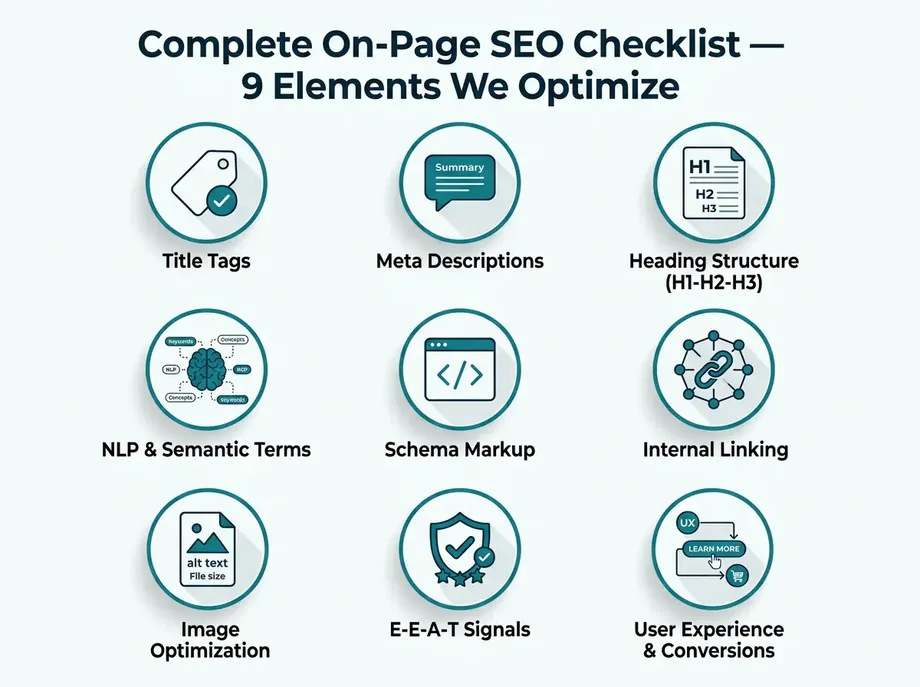
The title tag is the single most important on-page ranking factor. We write titles that include the primary keyword naturally, stay under 60 characters so they don't get truncated, and compel clicks from the SERP. Meta descriptions don't directly affect rankings, but they affect click-through rate — which indirectly impacts rankings. We write meta descriptions that include the target keyword, highlight a clear benefit or differentiator, and include a call to action. Every page gets a unique, hand-written title and meta description. No templates, no auto-generated tags.
Heading Structure and NLP-Friendly Content Architecture
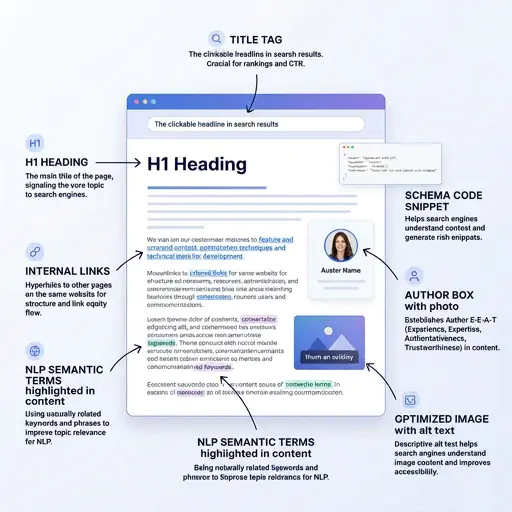
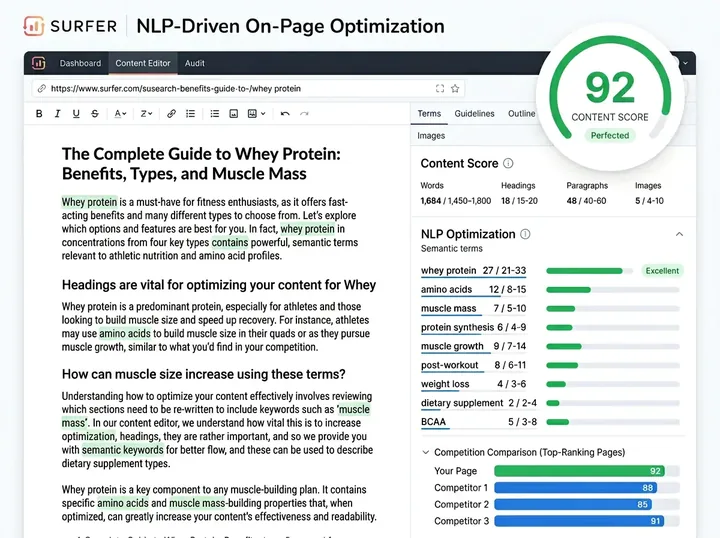
This is where most agencies stop at H1 optimization and move on. We go much deeper. Google's Natural Language Processing algorithms parse your heading structure to understand what your page covers. A well-structured page with clear H1 → H2 → H3 hierarchy helps Google understand topic coverage and content depth. We use Surfer SEO's content editor and NLP analysis to identify the exact semantic terms Google expects on a page for a given keyword, along with their target frequency ranges. For example, if you're targeting 'best protein powder,' Surfer's NLP analysis might show that top-ranking pages mention 'whey protein' 21-33 times, 'amino acids' 8-15 times, and 'muscle mass' 5-10 times. We structure content to hit these NLP targets without keyword stuffing. We also write NLP-friendly answer blocks — echoing the search query in the heading, giving a direct answer, and including correct units or specifics. This is how you win featured snippets.
Content Optimization (Without Losing Your Brand Voice)
We don't rewrite your content into generic SEO copy. We optimize it — tightening the structure, adding missing semantic terms, improving readability, and ensuring every section serves both the user and the search engine. Using Surfer SEO's content audit, we score each page and identify gaps: missing NLP terms, weak heading coverage, insufficient content depth, or sections that don't match user intent. Pages scoring below 70 in Surfer's content score get a structured improvement plan. We also check for content that's too thin (under 300 words for pages that need depth) or too bloated (3,000 words when 1,500 would satisfy the intent). The right word count depends on what's ranking — we match or beat the top competitors' content depth for every target keyword.
Internal Linking and Topical Connections
Internal linking is one of the most underused on-page SEO levers. Most websites have service pages and blog posts that exist in isolation — no links connecting them. This means link equity from your homepage and high-authority pages never reaches your deep pages. We build internal linking plans that connect related pages using keyword-rich anchor text, push authority from high-traffic pages to pages that need ranking boosts, create topical clusters where a pillar page links to supporting content and vice versa, and eliminate orphan pages that have zero internal links pointing to them. Surfer SEO's audit tool identifies specific internal linking opportunities — showing which pages on your site are topically relevant to each target page and should link to it. We've seen pages jump from position 30+ to page 1 purely from fixing internal linking — no new backlinks, no content changes, just proper authority distribution.
Image SEO and Media Optimization
Images affect both user experience and SEO. We optimize every image on a page: descriptive file names (not IMG_4582.jpg but 'on-page-seo-checklist-techpullers.jpg'), alt text that describes the image AND includes relevant keywords naturally, image compression for faster load times without quality loss, lazy loading implementation so images don't block page rendering, and proper image dimensions to prevent Cumulative Layout Shift (CLS). For pages with video embeds, we add VideoObject schema and optimize thumbnail images. Every media element on the page should be working for your SEO, not against it.
E-A-T Signal Building (Author Authority and Trust)
Google's Quality Rater Guidelines put heavy emphasis on E-E-A-T — Experience, Expertise, Authoritativeness, and Trustworthiness. On-page E-A-T signals are critical, especially for YMYL (Your Money or Your Life) topics like healthcare, legal, and financial services. Here's what we implement on every page that needs E-A-T signals. Author boxes on every content page — with the author's real name, photo, professional bio, credentials, and contact email. This isn't optional anymore. Google's algorithms use author entities to evaluate content trustworthiness. We implement author boxes at the WordPress theme level (in header.php or the theme framework), not through plugins that add bloat. Organization schema linking your site to your Google Business Profile, YouTube channel, and social profiles. Team pages with individual bios, qualifications, and contact information for each team member. About and Contact pages with physical address, phone number, email addresses for different departments, and links to all verified profiles. These trust signals compound. A page with a named author, proper credentials, and verifiable contact information scores higher in Google's quality evaluation than identical content without these signals.
Schema Markup Implementation
Schema tells Google exactly what your content represents. We implement JSON-LD structured data for: Article schema with headline, author, publisher, datePublished, and dateModified. Organization schema with name, URL, logo, contact points, area served, and social profiles. Product schema with offers, pricing, availability, ratings, and reviews for ecommerce pages. FAQ schema for question-and-answer sections — enabling FAQ rich snippets in search results. BreadcrumbList for navigation context. Person schema for author pages linking to their credentials and social profiles. We don't use schema plugins that generate bloated, often incorrect markup. Our dev team implements schema directly in WordPress theme files or Laravel Blade templates — clean, validated JSON-LD that passes Google's Rich Results Test every time. Schema doesn't directly boost rankings, but it enables rich snippets that increase click-through rates by 20-30%. More clicks at the same position means more traffic — and eventually higher rankings.
On-Page UX and Conversion Optimization
SEO without conversion optimization means you're driving traffic that doesn't convert. We align every on-page change with user experience and conversion fundamentals: clear CTAs above the fold and at natural decision points, readable content with proper paragraph length (3-4 sentences max), mobile-responsive layouts that don't break on smaller screens, fast-loading pages (we coordinate with our technical SEO team on speed), logical page flow that guides the visitor from awareness to action, and trust signals (reviews, certifications, guarantees) placed where they influence purchase decisions. When a page ranks well AND converts visitors into customers, that's on-page SEO done right.