Our keyword research service finds the keywords that can actually rank for your business, with the right intent behind them. We use Ahrefs and Google Keyword Planner to do it, cluster the keywords by intent, and align every one of them to what your business is trying to achieve.

Comprehensive keyword research is the foundation of any SEO campaign designed for success. Several businesses and SEO agencies get this done incorrectly. The right way to find keywords involves a detailed analysis of 100s, and maybe 1000s, of keywords, their search intent, search volume and the ranking difficulty. Once this is done, we can figure out the final keywords from the broader list to draw the SEO roadmap and timeframe.
Techpullers, an SEO company in Kerala, gets you a complete list of keywords that includes matching, related and search suggestion terms. We use Ahrefs and Google Keyword Planner to find search terms and the search volume. We go for informational and transactional, short and long tail keywords. Once this is done we work on the keyword search intent, and we will provide you with a detailed keyword cluster sheet to avoid cannibalization. The difficulty of each cluster will be analysed by going through the pages ranking on Google, their PR and DR, to let you know how much effort and time has to be put in. Finally you can work on the website sitemap, and you know what kind of pages are to be built.
We have completed keyword research for many industries. Some turned out to be our clients while others just had the research done, but in all cases we followed the same process. We have executed keyword research for several industries like fashion brands, interior designers, clinics, hospitals, construction firms, ERP companies, logistics, real estate, law firms, health and fitness, home appliances, automation, SAP, and many more. The countries other than India include the GCC, UAE (Dubai, Abu Dhabi, Ajman), Qatar, Kuwait, Bahrain, Australia, Malaysia, Singapore, the United Kingdom, Canada and the United States.
There are a few clients whose keyword research itself changed their website visibility. One healthcare client came to us ranking for terms nobody actually searched, because the keyword list they had been given before was full of zero search volume keywords. It was really disappointing to see. Once we rebuilt the keyword foundation, they could finally rank for the terms that bring in real patients.
Keyword research is about finding the search terms that are actually useful for your business. If a person lands on your website while searching for exactly the service, product or consultation you provide, then that search term is one you should add to your keyword list. Beyond the direct transactional terms, there are informational keywords that help people make the right decision. There is a group of people out there for whom you built your products and services. You want to get found when they search for that product or service, and then show them why you are the best among the plenty of options online. For all of this you need to find the terms they search, the exact match, the broad terms and the modifiers. That is why you need a professional team to get the keyword research done.
After collecting all the keywords related to your business, the next step is to find the intent of each keyword. This basically means understanding what the person searching with a specific keyword expects from the search results. We do this manually, going through every page ranking for a keyword, whether it is a product, a blog, the homepage or a service page. Based on this you can figure out what terms and pages you need to include and build. Once this is done, we cluster the keywords into groups to avoid cannibalization, which again is done manually by going through the search results.
So you get a keyword list, the search intent, keyword clusters, and additional keywords to publish as blogs or insights. This is the foundation of any SEO campaign. From this one key step you can create the sitemap and plan your pages. It's also the starting point for any wider digital marketing strategy, since the same keyword and intent data guides paid search, content and audience targeting.
You need keyword research if any of these sound like you:
Alsirhan Shoes, a footwear retailer in Kuwait, is one of our eCommerce keyword research wins. They came to us with effectively no organic presence. We built the keyword research from scratch, clustered the keywords by intent, and mapped every page before the content went out. Today they rank for 292 organic keywords in Kuwait, 121 of them in the top 3, pulling around 3,500 organic visits a month (Ahrefs).
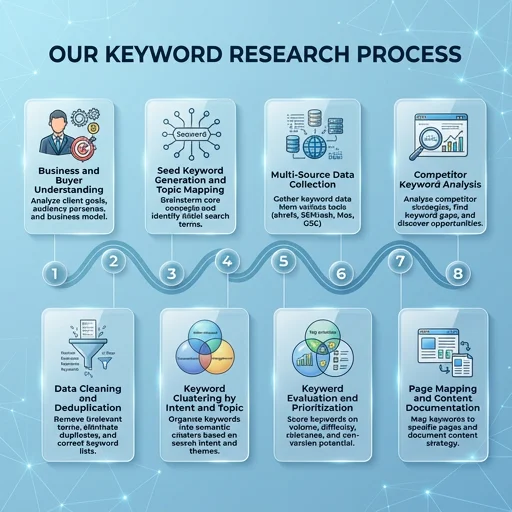
Before we open any tool, we understand your business. We specifically ask for your business details, your product, service, location, target market, objectives and competitors. A dental clinic in Kochi searches differently from one in Dubai, so the research has to start from your context.
We start with seed keywords. These come from tools like ChatGPT or Claude, and we also use modifiers like "best" and "top" and go to the search suggestions. We put these seed keywords and modifiers into the keyword research tools, mainly Ahrefs and Google Keyword Planner, to explore matching, related and suggested keywords. We also look into questions and long tail keywords. Then we combine all of this into a single sheet.
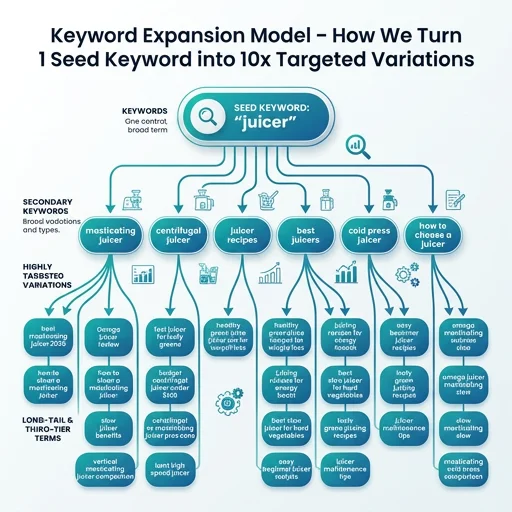
We don't rely on one tool. Ahrefs gives us matching terms, related terms and search suggestions, and we get a big list from there itself. Google Keyword Planner gives us the exact search volume and shows if there are any gaps.
We pull competitor keywords to find the gaps you can realistically win. This is usually done in Ahrefs. We check the keyword pages and the competitor's DR and PR to judge whether we can beat them for a particular keyword and how long it will take. If their DR and PR are high, it will take more time and effort. It is better to target long tail keywords with high search volume and low competition if you are just getting started.
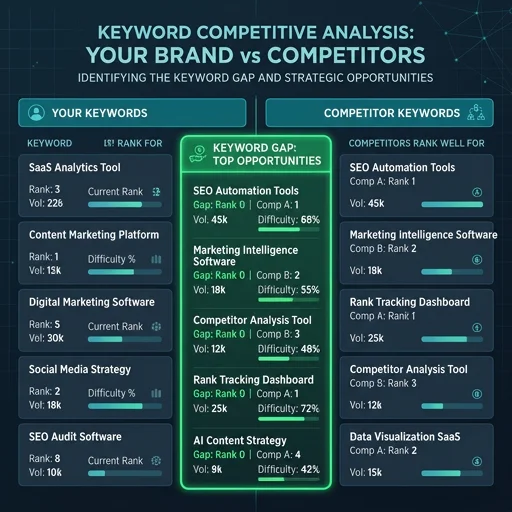
We found a lot of gap for a perfume brand called Luxury Concept. Their competitors are high DR and PR sites, so we found some long tail, high volume keywords for them to begin with, before directly competing for the main terms, which might take time.
A tool cannot precisely understand what your business objectives are. It is most likely that irrelevant terms get included while some relevant ones get omitted. This is the main reason why you need to discuss with a professional SEO person. I would recommend you sit down with them, analyse the keywords from the perspective of your potential customer, and finalise the keywords that perfectly suit your business. The SEO team will later remove the irrelevant keywords and duplication.
Keyword clustering is what we consider one of the most indispensable steps, and the one most SEO agencies in Kerala usually ignore. I think this is important because it will help with future cannibalization issues. If this is not done properly, you will end up creating duplicate pages for the same cluster of keywords, which obviously should point to one page. Learn more in our guide on keyword clustering for SEO.
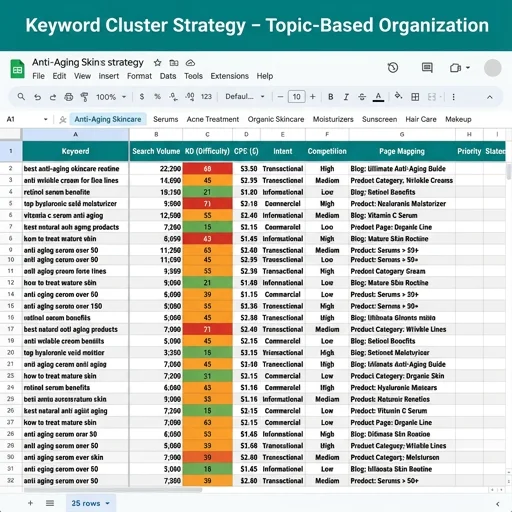
Here is a simplified sample from one of our real keyword cluster sheets, showing how each cluster is split by intent. Each cluster maps to one page, and the intent (commercial or informational) decides the page type.
| Cluster | Intent | Primary keyword | Primary volume | Total cluster volume |
|---|---|---|---|---|
| Oud Perfume (general) | Commercial / product | oud perfume | 2,200 | 3,400 |
| Arabic Perfume (brand / collection) | Commercial / category | arabic perfume | 800 | 2,300 |
| Perfume Gift Sets | Commercial / category | perfume gift set | 250 | 1,760 |
| Eau de Parfum vs Extrait | Informational / blog | eau de parfum meaning | 350 | 860 |
| What is Oud | Informational / blog | what is oud | 250 | 250 |
The full sheet for this project had 17 clusters across commercial and informational intent, each on its own tab with every keyword, its volume, difficulty, CPC, and the competitor URLs ranking for it.
We decide which cluster group to target based on the inputs you give us. You let us know what you want first, and we give you all the information on those keywords like volume, difficulty, intent, current position, and a tentative time to get the keyword ranking. We would certainly advise you to go for the low hanging keywords first and then gradually target the difficult and generic terms. We also have monthly plans where we add two to three blogs targeting long tail questions. The pages are built in the first phase itself, and off page work is based on which ones you want to target first. Now this varies from industry to industry. Often service sectors start off with all the service pages and gradually improve visibility with blogs. Whereas several eCommerce sites need selected products to sell faster, so they prefer giving foremost attention to the corresponding keywords.
Keyword mapping is what comes after keyword clustering. We create a well planned website sitemap based on the keyword clusters. Each keyword cluster group is mapped to the associated pages based on the intent. The page type, whether products, categories, services or insights, has to be planned based on the keyword intent.
We find the right keywords for a profitable business, not just high numbers.
Using the same keywords or their synonyms on multiple pages, which causes cannibalization.
See how we applied this approach for Fotis Law.
Publishing your website without a keyword strategy. In most cases we see, you will have to revamp the site later.
One tool won't give you the exact keyword strategy you need. Professionals and your own rationale are required to figure this out.
₹10,000 – ₹50,000
A one-time keyword research project ranges from ₹10,000 to ₹50,000, depending on scope. Keyword research is also included in our monthly SEO retainers, which start at ₹25,000/month, and is refreshed quarterly. Every engagement starts with a free initial assessment, where we look at what you are targeting, the organic traffic you get, and how it can be improved. See our full SEO pricing for details.
We use Ahrefs, Moz and Google Keyword Planner, along with the live search results and our own logic, not a single automated export.
We cluster the keywords in groups so you avoid cannibalization and duplicate pages.
We have done this for fashion, interiors, healthcare, construction, ERP, logistics, real estate, law, fitness and more.
Every project includes competitor keyword analysis and how to gain the upper hand.
Several clients approached us with their website when it didn't rank. I understood that most SEO agencies in Kerala don't get the keyword research done properly. Their keyword research hardly takes 30 minutes to an hour. They just figure out 10 to 20 terms and that's it. They give a report focused only on those 10 to 15 terms. They do not consider topical authority or wider visibility, so there is no long term SEO plan.
Honestly, almost all my clients are keyword research wins. The latest ones come in, we do the keyword research, the clusters, the documentation and the website sitemap, then publish the pages. After good on page optimization and a few directories, most local businesses turn up on the first page. See our case studies for examples.
Start with a free initial assessment. We will show you the organic traffic you currently receive, the keywords you rank for, and what your competitors receive and rank for, before you commit to anything.
Get Free AssessmentWe are located in Infopark , Kochi
Our Office