Google Penalty Recovery Service
Your website’s organic traffic suddenly drops by 50%, 70%, or even 90%. Your once-ranking keywords vanish from search results. You search your site name in Google and find nothing. That sinking feeling means you’ve likely been hit by a Google penalty.
Whether it’s a manual action from Google’s review team or an algorithmic hit from a core update, a penalty can cripple your online visibility and revenue. But penalties are recoverable. At Techpullers, as an SEO company in Kerala with 8+ years of experience, we’ve helped businesses across India and internationally bounce back from both manual actions and algorithm hits. We combine Ahrefs backlink analysis, manual toxic link review, and transparent recovery strategies to restore your rankings and traffic.
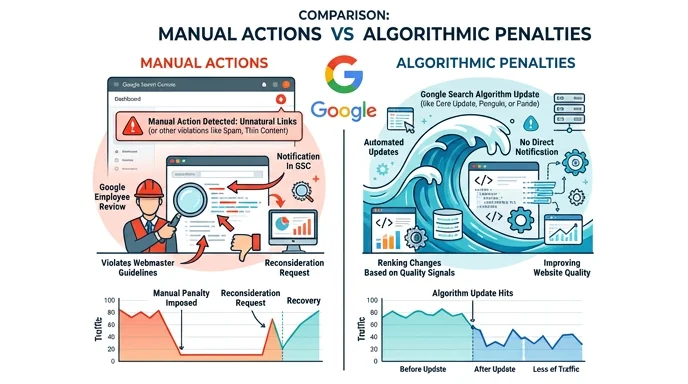
Get Your Free Penalty DiagnosisA Google penalty is a demotion or removal of your website from search results as a consequence of violating Google’s Webmaster Guidelines. Google applies penalties in two main ways: manual actions (human review) and algorithmic penalties (automated systems). Both hurt your visibility, but they’re diagnosed and fixed differently.
Manual actions are enforced by Google’s human reviewers after they detect guideline violations on your site. Google sends a notification in Google Search Console, and the action typically targets specific pages or your entire domain.
Common manual actions include unnatural links to your site, user-generated spam, cloaking or sneaky redirects, thin content with little or no value, and hacked content or malware.
Algorithmic penalties result from automated algorithm updates — like Penguin (links), Panda (content quality), or core updates — that devalue sites failing to meet quality standards. Google doesn’t send a notification for algorithmic hits. Instead, you notice rankings and traffic dropping after an update rolls out.
The key difference: manual actions require a reconsideration request to Google after fixes. Algorithmic penalties require patience and continuous improvement as the algorithm adjusts. Understanding which type hit your site is the first step in any google penalty recovery process.
Google’s review team investigates thousands of sites and issues manual actions when they find clear violations.
Links from link networks, site-wide footer links, or obviously manipulative sources trigger this action. Recovery requires identifying and disavowing these links using the Google Disavow Tool.
This catches sites using exact-match anchor text excessively or linking from irrelevant, low-quality sites. A thorough backlink audit isolates the toxic links responsible.
If your forum, comments section, or user-submitted content is full of spam links, Google penalizes you. Cleanup requires removing spam and moderating future submissions.
Showing different content to Google than to users, or redirecting users to unrelated pages, triggers immediate action. A technical audit catches both issues.
Pages with minimal, duplicate, or low-value content that don’t serve user intent face penalties. Recovery involves rewriting, consolidating, or removing these pages.
Malware, injected links, or unauthorized content result in automatic penalties. Recovery requires identifying compromised pages and securing your site.
These updates roll out globally and affect millions of sites. Recovery requires improving your site’s overall quality and relevance.
Penguin targets sites with unnatural linking patterns, toxic backlinks, and over-optimized anchor text. Since the 2016 real-time Penguin, quality improves as you fix links and earn authoritative backlinks — you don’t have to wait for the next update.
Panda demotes thin, duplicate, or low-engagement content. Recovery means creating original, in-depth, user-focused content that demonstrates genuine expertise.
Google releases broad core updates several times yearly to improve overall search quality. Sites lose rankings if they don’t meet user expectations for expertise, authority, and trustworthiness (E-E-A-T). Recovery requires holistic improvements across technical, on-page, and off-page SEO factors.
Recognizing a penalty early lets you act fast. Here are the warning signs to watch for.
If organic traffic falls 30%, 50%, or more overnight or within a few days, you’ve likely hit a penalty. Check your Google Analytics timeline against Google update announcements.
If dozens or hundreds of keywords drop simultaneously — especially branded and money keywords — a penalty is likely. Tracking tools and a google penalty checker approach using Search Console data can confirm this.
This is the clearest signal. GSC shows “Manual actions” in the left sidebar if Google’s team has penalized you. The notification identifies the specific violation type.
Check the Coverage report in GSC. If indexed pages drop sharply without explanation, Google has likely deindexed pages due to quality issues or penalties.
Search your site name or specific page titles. If your own pages don’t appear, a penalty is almost certain.
Sometimes your site still appears in search but with much lower CTR. This suggests algorithm demotions for relevance or quality rather than a full manual action.
If you’re seeing these signs, understanding what Google penalties look like and why websites fail to rank is the first step toward recovery.
We’ve recovered sites from both manual actions and algorithmic penalties across law firms, healthcare, ecommerce, dental practices, logistics, and more. Our google penalty recovery services process is transparent, data-driven, and proven.
We start by identifying whether you have a manual action, algorithmic penalty, or both.
We audit your Google Search Console for manual action notifications, reading the details carefully to understand exactly what Google flagged. We compare your traffic and ranking drops to Google’s confirmed update timeline — if drops align with Penguin, Panda, or core updates, we know the penalty type. We pull historical GSC data, Analytics traffic history, and ranking data to pinpoint when the drop occurred. We also check whether competitors in your industry experienced similar drops — if they did, it’s likely a broad algorithm update; if not, it’s site-specific.
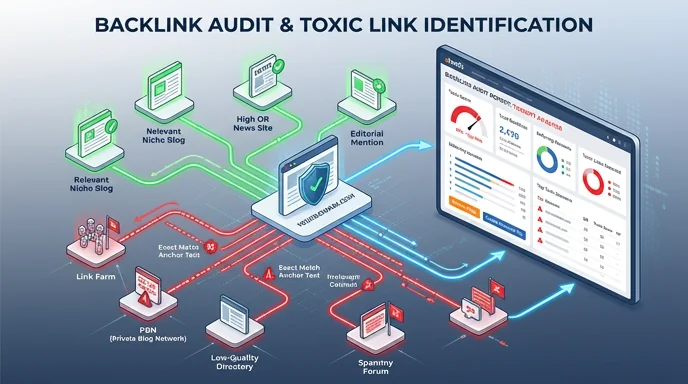
Most penalties involve link issues. Using Ahrefs and manual review, we identify toxic, unnatural, or low-quality backlinks.
We analyze link velocity (sudden spikes from link networks), anchor text distribution (over-optimization of exact-match keywords), source quality (low-authority, irrelevant, or spammy domains), link types (footer links, site-wide links, blog network links), and relevance (links from unrelated industries). We create a comprehensive toxic link report listing every domain and URL to target for disavowal or removal.
We pursue two strategies simultaneously.
Link removal outreach: we email webmasters of sites linking to you and request link removal. Removed links are more effective than disavowed ones. We track responses and follow up persistently.
Google Disavow File: for links we can’t get removed, we create a clean disavow file and submit it via Google Search Console. This tells Google to ignore those links when evaluating your site. We document every link we disavow with clear reasons (private link network, paid link, unrelated source).
We avoid over-disavowing. Disavowing legitimate links can slow recovery and signal confusion. We’re surgical and strategic — only truly toxic links get disavowed.
Algorithmic and some manual penalties stem from content quality. We audit and improve your content.
We address thin content (pages with minimal value — we expand, merge, or remove them), duplicate content (internal duplicates and near-duplicates — we consolidate and optimize), outdated information (stale stats, dates, and references get updated), low engagement pages (improved readability, structure, and user intent alignment), keyword stuffing (artificial keyword density removed and rewritten naturally), and shallow topical coverage (added depth with well-researched content).
All content is rewritten to match user search intent and E-E-A-T signals — experience, expertise, authoritativeness, and trustworthiness.
For manual actions, after we’ve addressed all violations, we submit a reconsideration request to Google.
Our reconsideration request includes a detailed explanation of every violation found, clear description of actions taken to fix each one, evidence of changes (before/after documentation, removed pages, rewritten content), timeline of corrections, future prevention measures, and our certification that the site now complies with Google’s guidelines.
Google doesn’t guarantee reconsideration success on the first attempt. Sometimes it takes 2–3 requests. We monitor GSC and adjust our approach based on Google’s feedback.
Recovery doesn’t end with a reconsideration request. We monitor your site and help prevent future penalties.
Ongoing monitoring includes weekly ranking and traffic tracking, monthly backlink analysis for new toxic links, quarterly content audits and updates, GSC monitoring for new manual actions or warnings, algorithm update awareness and proactive adjustments, and alerts for sudden changes.
Prevention measures include establishing link-building guidelines (only relevant, high-quality sources), recommending content calendars with fresh authoritative content, educating your team on Google’s guidelines, and conducting annual SEO audits to catch issues early.
Once you’ve recovered, staying penalty-free is critical.
Pursue links from relevant, high-authority sites in your industry. Guest posting, partnerships, and earned media are sustainable. Avoid link networks, paid links, and footer/sitewide links entirely.
Write comprehensive, well-researched, original content. Demonstrate expertise and cite credible sources. Update content regularly to keep it current.
Use tools like Ahrefs to review your backlink profile monthly. Disavow new toxic links immediately before they accumulate.
Avoid cloaking, sneaky redirects, auto-generated content, and keyword stuffing. Google’s guidelines evolve — staying current prevents accidental violations.
Keep your site secure with HTTPS, regular updates, and malware scans. Hacked sites face quick penalties.
Page speed, mobile responsiveness, and layout stability matter. Core updates reward sites with excellent user experience.
Create comprehensive content clusters around your main topics. Topical authority builds resilience against algorithm updates because Google recognizes your site as a genuine expert in your space.
CEO Aiswariya Kolora has recovered sites from manual actions and algorithmic penalties across diverse industries — law, healthcare, ecommerce, dental, logistics, and more — in Kerala and internationally.
We don’t rely on tools alone. We use Ahrefs to identify toxic links, then manually review each one in context. This reduces false positives and disavowal mistakes.
We understand the Disavow Tool deeply. We know when to use it, when to pursue removal instead, and how to avoid disavowing legitimate links that could slow recovery.
We clearly distinguish manual actions from algorithmic penalties using GSC data, timeline analysis, and competitive benchmarking. Correct diagnosis drives the right recovery strategy.
We share every step — backlink reports, disavow files, content audits, reconsideration requests, and monitoring dashboards. No black boxes.
Aiswariya stays updated on the latest Google algorithms, manual action trends, and recovery best practices. We adjust strategies as Google’s guidelines evolve.
Beyond seo penalty recovery, we offer SEO audit services, off-page SEO, technical SEO, and content strategy. We fix your penalty and build long-term SEO resilience.
Manual action recovery typically takes 6–12 weeks from diagnosis to reconsideration approval, depending on the violation’s severity and the comprehensiveness of fixes. Algorithmic penalty recovery takes longer — often 3–6 months — as it requires continuous improvement and sometimes waits for the next algorithm update. We provide realistic timelines based on your specific situation.
No one can guarantee reconsideration approval. However, our google penalty recovery process gives you the best chance: we identify every violation, fix each one thoroughly, and submit detailed reconsideration requests with full documentation.
You might have an algorithmic penalty. These don’t trigger GSC notifications. We diagnose algorithmic penalties by comparing your drop timeline to Google’s update timeline, analyzing your backlink profile for Penguin issues, and auditing your content for Panda issues. Recovery requires patience and continuous improvement.
No. Over-disavowing can slow recovery and signal confusion. We disavow only truly toxic links — those from link networks, paid sources, unrelated directories, and spammy domains. Legitimate links, even mediocre ones, are kept.
If you have technical SEO knowledge, backlink analysis experience, and familiarity with GSC, you might recover your own site. However, most business owners lack this expertise, miss toxic links, or submit weak reconsideration requests. Professional google penalty recovery services reduce recovery time and increase approval odds.
Costs depend on your site’s size, penalty severity, and required fixes. Small manual actions with few toxic links cost less; large algorithmic penalties affecting hundreds of pages cost more. We provide transparent quotes after diagnosis. Get a free consultation to discuss your situation.
Hacked sites face quick penalties. We identify all compromised pages, remove injected content and malware, secure your server, and submit a reconsideration request. Recovery from hacking is often faster (4–8 weeks) because Google recognizes hacking as an external attack, not deliberate guideline violation.
Yes, but carefully. Focus on relevant, high-authority links from industry sources, not aggressive campaigns. Large, sudden link spikes during recovery can extend your penalty window. Quality over quantity during this phase.
We measure success by three metrics: GSC manual action clearance (for manual actions), organic traffic recovery to pre-penalty baseline, and keyword ranking restoration for core money keywords. Monthly reports track each metric throughout the recovery process.
If your site is penalized — or you suspect it might be — don’t delay. Google penalties compound over time. The longer you wait, the longer recovery takes and the more revenue you lose.
We offer a free penalty diagnosis. We’ll audit your site, review your GSC, analyze your backlink profile, and tell you exactly what happened and what recovery will require.
Get a free consultation with our penalty recovery team. No obligation, no pressure. Penalties are painful, but they’re recoverable — let’s get your site back on track.
No obligation · No pressure · Confidential review
We are located in Infopark , Kochi
Our Office