Every few years, SEO gets a new label. In 2026, it’s GEO (Generative Engine Optimization). The hype makes it sound like a completely new discipline. It’s not. Most GEO advice is modern SEO fundamentals— with one important new measurement layer: AI citations and brand mentions.
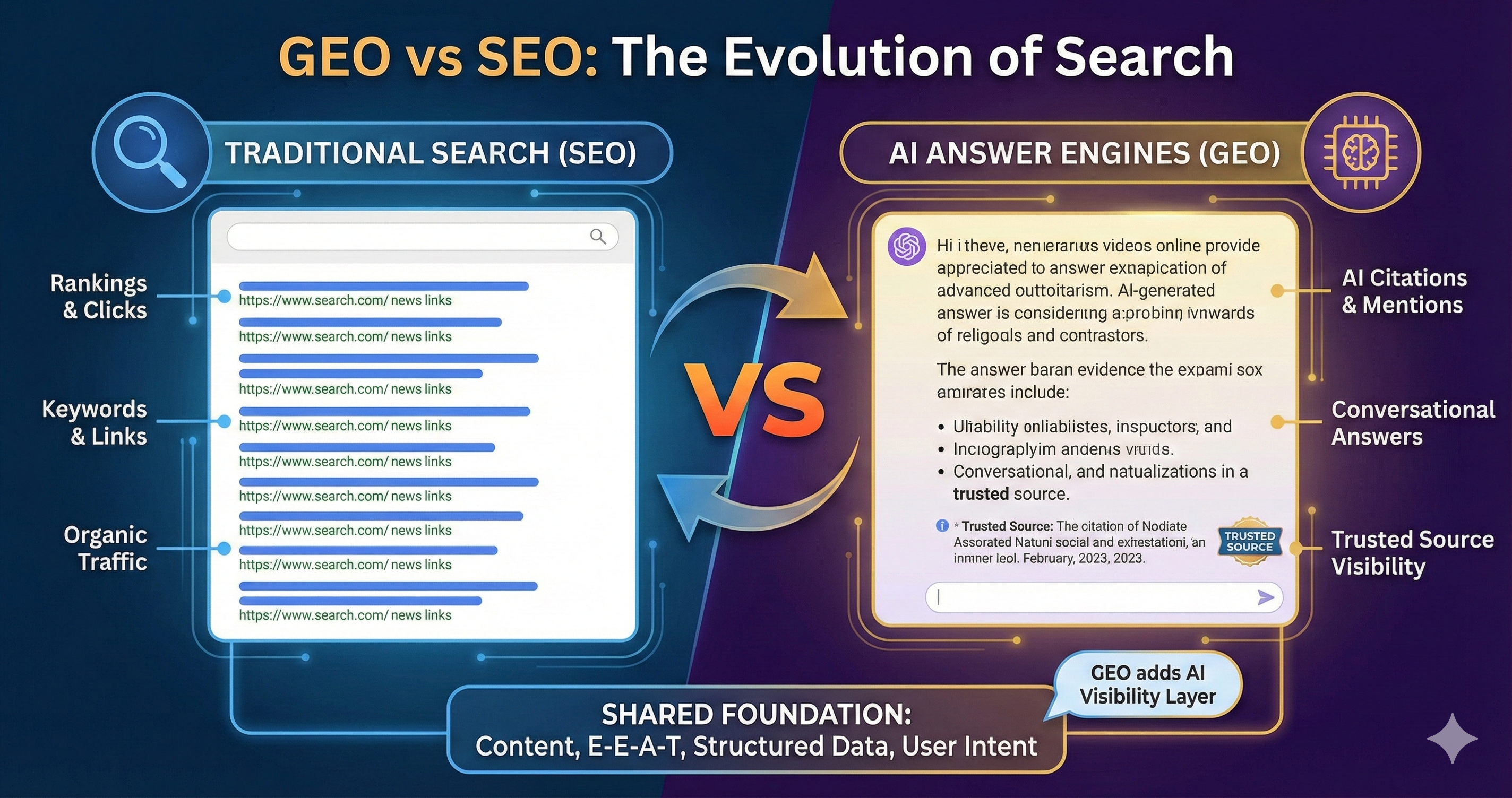
Let’s keep this simple. SEO is still the foundation. GEO is SEO with one new objective: being referenced inside AI-generated answers (AI Overviews, AI search experiences, and LLM platforms).
GEO is about improving visibility inside generative systems—so your brand/content gets cited, mentioned, or recommended when an AI generates an answer. Search Engine Land frames GEO as a sub-discipline inside the wider AI search shift: what GEO is and how to win AI visibility .
Most “GEO checklists” online are just modern SEO fundamentals with a new label: intent-led content, topic clusters, internal linking, schema, page experience, content refresh, and consistent brand presence.
Even Search Engine Land has published the idea that “good GEO is good SEO” — meaning you don’t throw away SEO, you refine it for AI-driven discovery: Good GEO is good SEO .
One big GEO talking point is: “focus on conversational keywords and questions.” SEOs have called this long-tail SEO for years.
Long-tail queries are usually more specific, lower competition, and often carry stronger commercial intent. Here’s a solid reference: Search Engine Land: long-tail keywords guide .
“watch” is generic. Intent is unclear. Competition is huge.
But “watch for kids with GPS” or “smartwatch for kids waterproof” is specific—and the user is closer to action.
That’s why long-tail has always been the practical win for SEO.
In fact, Search Engine Land recently framed AI optimization as long-tail SEO done right: Why AI optimization is just long-tail SEO done right .
Another GEO talking point is competitor research: track what competitors publish, what they rank for, and what sites cite them. SEOs have already done this using tools, SERP analysis, and backlink/citation tracking.
What’s new is the GEO layer: tracking AI citations and mentions. Not just “who ranks,” but “who gets referenced in AI answers.” Search Engine Land calls brand mentions a key metric for AI Overviews visibility: 7 ways to grow brand mentions (AI visibility) .
GEO discussions often mention “brand perception intelligence,” EEAT, comprehensive verified content, and proper structure. That’s not new—strong SEOs have done this for years through topic clusters, content hierarchy, FAQs, internal linking, and clean schema where it fits.
Google’s own guidance for succeeding in AI search experiences still points back to the same core idea: create unique, satisfying content that fulfills needs (especially as queries get longer and more specific): Google Search Central: Succeeding in AI search .
So yes: speed, mobile friendliness, HTTPS, architecture, internal linking, content refresh, social distribution— all of that is still foundational SEO.
Here’s the honest answer: the tactics are mostly the same. The real new part is where you measure visibility.
Traditional SEO reports focus on rankings, clicks, impressions, and CTR. GEO adds: are we cited/mentioned in AI answers? how often? for which prompts? compared to competitors? Search Engine Land even covers how to measure brand visibility in AI search: Measure brand visibility in AI search .
You can’t rely only on “our website ranks.” You also need consistent entity/brand presence across trusted third-party sources where AI systems tend to ground answers: citations, mentions, reviews, directories, industry sites, PR coverage, etc.
If you’re already doing serious SEO, GEO isn’t a reboot. It’s a new scoreboard. You keep the fundamentals—and you add AI citation/mention visibility tracking.

Writen by
Posted On
February 25, 2026
Aiswariya Kolora is a professional digital marketing strategist and SEO expert. As the founder of Techpullers, she crafts effective online marketing strategies that help businesses grow.
Leave a Comment
Your email address will not be published. Required fields are marked *