Google's Fastest Spam Update March 2026
What Really Happened, Who Got Hit, and How to Recover
Your competitor lost 60% of their organic traffic last Wednesday. They have no idea why. You might be next.
On March 24, 2026, Google deployed the fastest spam enforcement action in search history — and it changed everything about how fast consequences arrive.
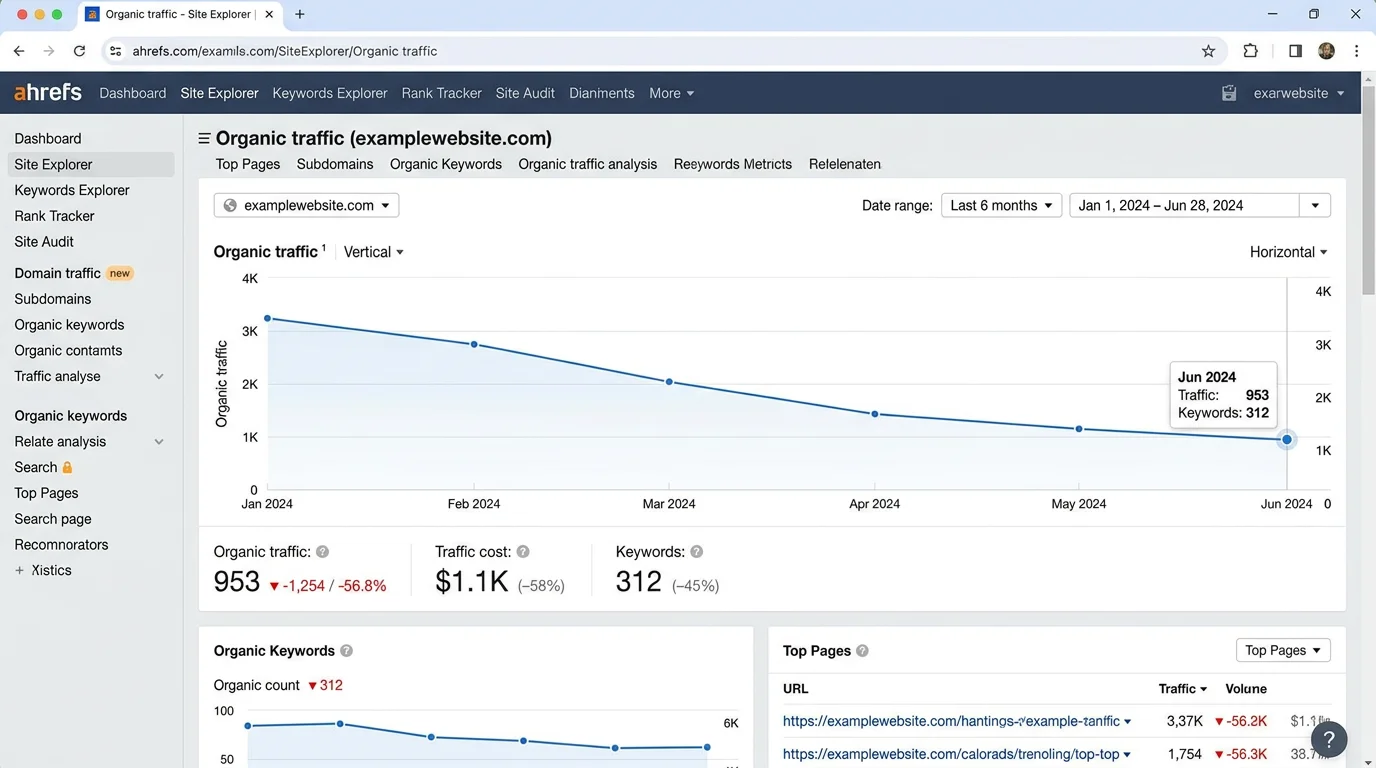
Ahrefs showing a dramatic organic traffic drop following the March 2026 spam update
On March 24, 2026, what many SEO professionals are calling Google's fastest spam update March 2026 appeared to hit search results without warning. No slow rollout. No gradual signal. Within a single business day, millions of pages were re-evaluated, hundreds of thousands of rankings shifted and entire websites that had spent years climbing Google's results simply ceased to exist in search.
The scary part? Most of the site owners affected didn't even know what hit them because their content looked fine. It was formatted correctly. It targeted the right keywords. It had backlinks. But Google's new enforcement didn't care about the surface. It cut straight to the core of why that content existed.
This isn't a standard post-update recap. This is a deep breakdown of what Google actually targeted, why this update was different, what the winners did right, and most importantly — exactly what you should do in the next 30 days to protect and recover your rankings.
The Update That Broke the Mould: What Made March 2026 Different
Google releases spam updates regularly. In 2023 and 2024, we saw multiple updates targeting link spam, AI-generated content, and scaled content abuse. But all of them shared one characteristic: they rolled out slowly, over days or weeks, giving site owners time to notice, report, and partially prepare.
March 2026 broke that pattern completely.
According to Google's Search Central Blog, the update was complete within hours of deployment. SEO tracking tools like Semrush and Ahrefs registered massive volatility signals before most site owners had even checked their dashboards that morning.
Three things made this update genuinely unprecedented:
Speed: Full enforcement in under 24 hours, not the usual 1–2 week rollout window.
Precision: The update didn't just catch obvious spam farms. It identified systematic content patterns across legitimate-looking websites.
Permanence: Unlike some updates where rankings partially recover within days, the drops from this update have shown strong persistence.
Behind all of this is SpamBrain, Google's AI-powered spam detection system that has been getting smarter with every update cycle. What March 2026 showed is that SpamBrain no longer needs days to evaluate a site. It can now assess content patterns, authority signals, and manipulation tactics at near real-time scale. This is not a rule change. It's a capability upgrade — and it changes everything about how fast consequences arrive.
What Google Actually Targeted: The Four Patterns
Let's be clear — saying "avoid spammy content" is not helpful. Google's March 2026 update targeted four specific SEO practices.
Pattern 1: Manufactured Content at Scale
This is the big one. Sites that used AI tools to generate large volumes of content without meaningful human editing, original research, or genuine added value were hit hardest.
We're not talking about a few AI-assisted blog posts. We're talking about content operations that published 50, 100, or 500 articles per month with near-zero editorial investment.
The tell-tale signs Google targeted:
Homogeneous writing style across hundreds of articles with no variation in voice
Topics chosen exclusively for search volume with no connection to the site's actual expertise
No original data, quotes, case studies, or first-hand perspective anywhere in the content
Pattern 2: Fake Authority Signals
Private blog networks (PBNs), expired domain redirects, and paid link placements on sites with no editorial standards. Google's link quality detection has been improving for years — this update appears to have deployed a significantly upgraded version.
Sites with sudden, unnatural links saw retroactive penalties in this update.
Pattern 3: Surface-Level Content
This one catches a lot of legitimate sites off guard. Surface-level content isn't always thin content. It can be 3,000 words long. It can be well-formatted. But it says nothing new. It covers the same points as the top 10 results, reworded, with no original insight, expert opinion, or unique angle.
Google's quality evaluators — and now its automated systems — are increasingly able to identify content that occupies space in a niche without contributing to it.
Pattern 4: Systematic SEO Templates
Automated internal linking patterns, mass-produced location pages with only the city name changed, templated service pages duplicated across hundreds of categories. The pattern itself is now the red flag, not just individual pages.
Ask yourself this honestly: If Google removed your entire site from search tomorrow, would your industry notice? Would real people miss your content? If the answer is uncertain, that is your roadmap.
Why Some Sites Gained Traffic While Others Collapsed
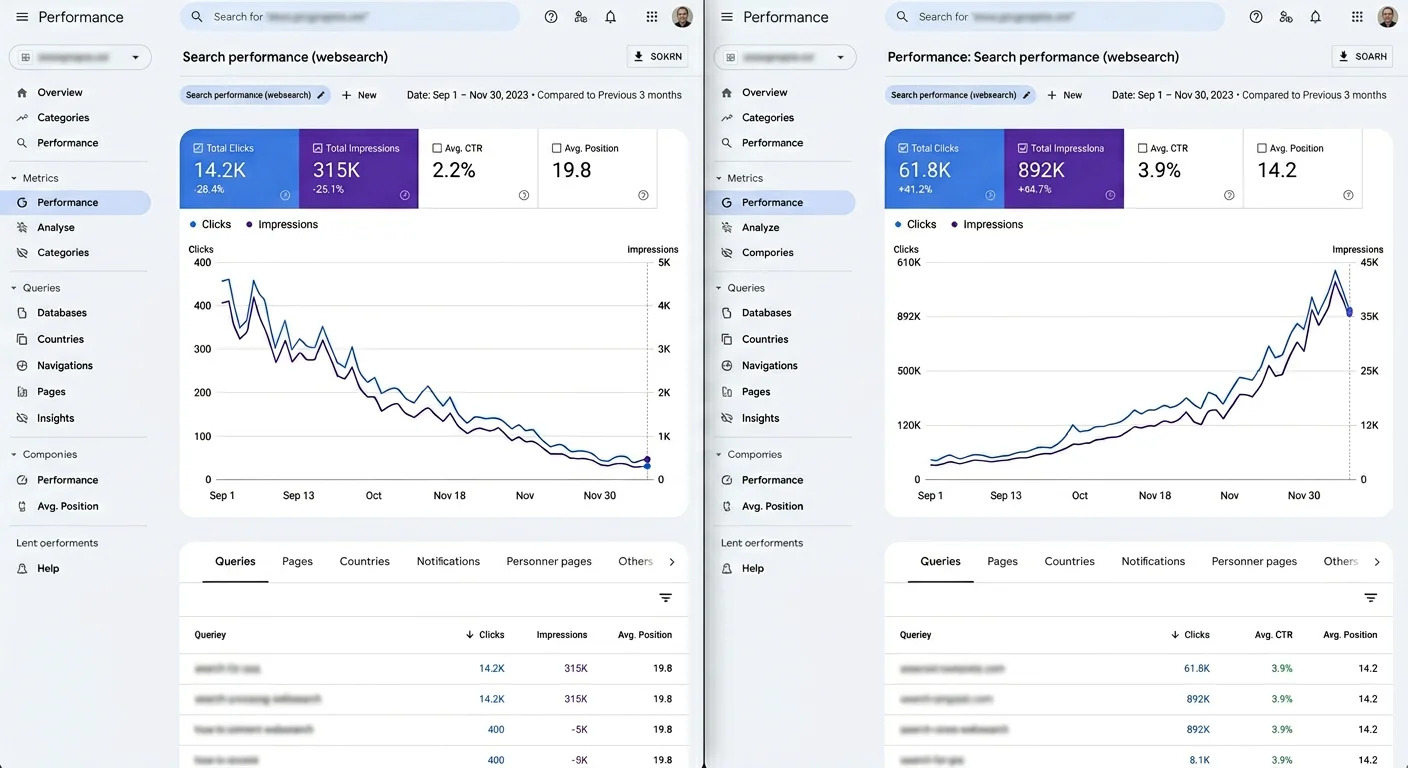
Every ranking that disappears has to go somewhere. When thousands of pages lose their positions simultaneously, the pages that move up are the ones worth studying.
Google Search Console comparison: a penalised site (left) vs a site that gained rankings (right) after the March 2026 update
The March 2026 update produced clear winners. Here's what they had in common:
Original research and data: Articles with proprietary surveys, internal case studies, or genuinely unique data points. Content nobody else could have written.
Named, credentialed authors: Real people with verifiable expertise. LinkedIn profiles. Conference talks. Published work elsewhere. Not anonymous bylines.
Consistent brand voice: Sites where every piece of content feels like it came from the same human perspective with opinions, preferences, and a recognisable style.
Lower publishing frequency, higher quality per post: The winning sites typically published 4–8 articles per month, not 40.
Google is no longer rewarding who publishes the most. It's rewarding whoever says something genuinely worth reading — and it now knows the difference faster than ever.
How to Tell If Your Site Was Affected Without Guessing
Before you take any action, you need to diagnose correctly. A traffic drop isn't automatically a spam penalty. Here's how to know for certain.
Strong indicators of a spam update impact:
A sharp, sudden traffic drop between March 24–25, 2026 — not a gradual decline over weeks
Multiple pages across different topics all losing rankings simultaneously
Specific pages disappearing from Google's index entirely (check via site: search)
A Manual Action notification in Google Search Console (check under Security & Manual Actions)
Your rankings dropped on the same day SEO tracking tools reported high volatility
What it's probably NOT:
A gradual decline over several weeks — that's likely a content quality drift, not a penalty
1–3 pages losing rankings — that's page-level quality issues, not a site-wide action
A traffic drop only in Google Analytics but not Search Console — check for tracking issues first
The Recovery Plan: What to Do in the Next 30 Days
Recovery from a spam update is not a quick fix. But it is absolutely possible with the right approach. Here's what we recommend, in priority order.
Week 1: Audit and Triage
Export all your pages from Google Search Console. Identify which pages lost rankings and by how much.
Categorise each affected page: Can this be significantly improved? Should it be merged with another page? Should it be removed?
Be ruthless. A smaller, stronger site will outrank a large, weak one every single time. Pages that add no unique value are not neutral — they actively harm your domain's quality perception.
Week 2: Backlink Audit
Pull your full backlink profile using Google Search Console's Links report or tools like Ahrefs.
Flag links from PBNs, low-DA directories, or sites with no clear editorial purpose.
Build a disavow file and submit it through Google's Disavow Tool. Don't disavow everything — only clear spam.
Week 3–4: Content Upgrade
Select your 10 most important pages (highest business value, not just traffic) and upgrade them seriously.
Add original insight: a client case study, a data point from your own experience, an expert quote, a contrarian take.
Remove filler: Every paragraph that restates something already said earlier in the article needs to go.
Add author credentials: Named authors with visible expertise are a significant trust signal.
Remember: Recovery isn't about convincing Google you've changed. It's about actually changing — and then being consistent long enough for Google's systems to re-evaluate your site. Expect meaningful recovery to take 2–3 months of consistent effort.
The Permanent Shift: What This Update Really Signals for SEO
Here's the uncomfortable truth that most SEO blogs will gloss over: the March 2026 update is not an anomaly. It's a preview.
Google has been investing heavily in real-time quality assessment infrastructure for the past 18 months. This update showed what that infrastructure can do when turned on. The gap between publishing bad content and facing consequences just collapsed from weeks to hours.
What this means for your SEO strategy going forward:
Volume is now a liability, not an advantage: Every low-quality page on your site is an active risk, not just a wasted opportunity.
AI tools are not the enemy — carelessness is: AI-assisted content can absolutely rank if it's edited, enriched, and genuinely useful. The problem is publishing AI output raw, at scale, without human judgment.
Brand authority is the only true moat: Sites with real expertise, real authors, and consistent voice become increasingly difficult to displace and increasingly resistant to algorithm enforcement.
SEO and content strategy must merge: You can no longer have a content team that writes and an SEO team that optimises separately. Quality and search performance are now the same thing.
Spam Update vs Core Update: Know the Difference
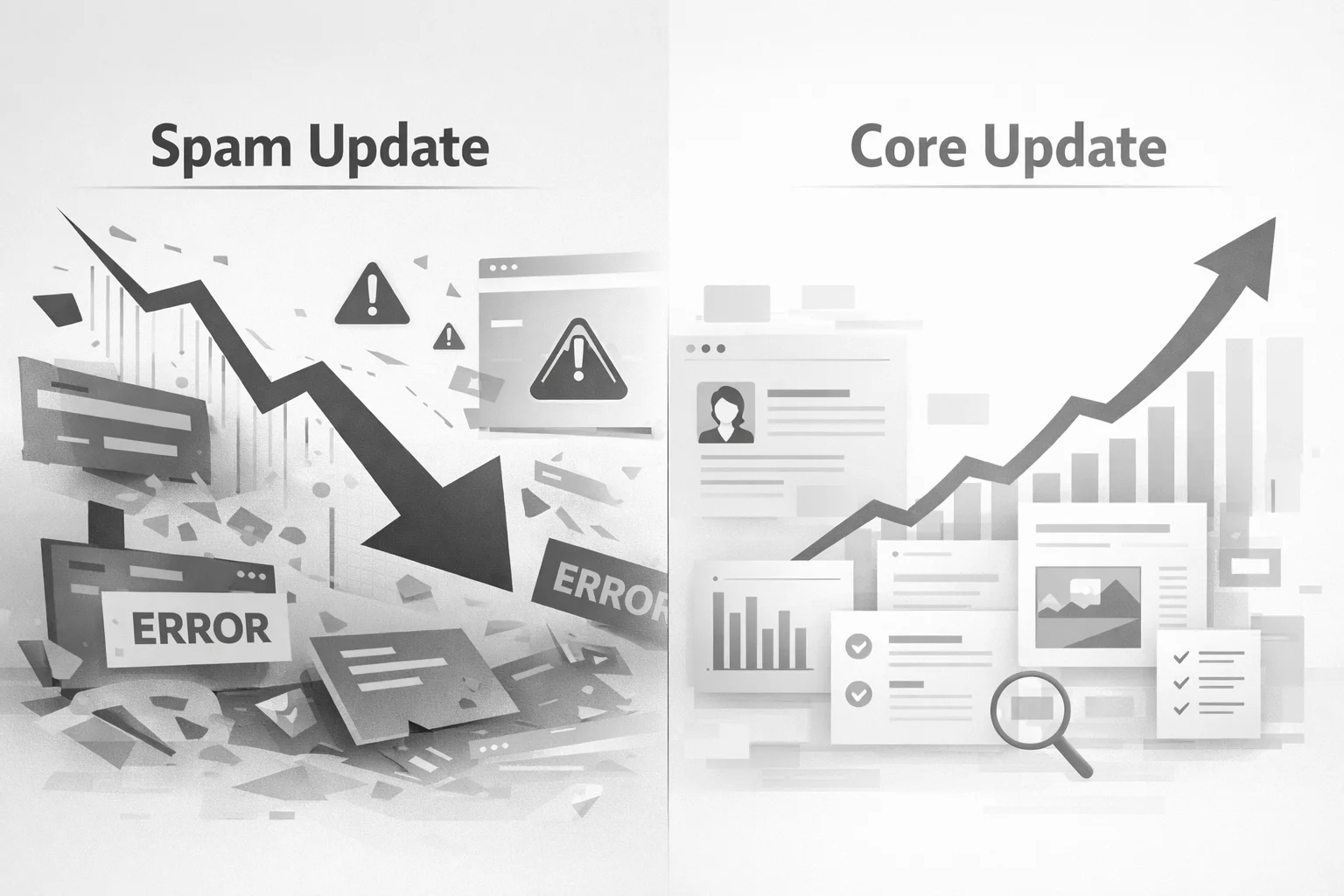
Spam updates cause sudden drops from policy violations, while core updates gradually re-order rankings based on quality signals
These two update types require completely different responses. Confusing them leads to wasted effort and delayed recovery.
Spam Update
Core Update
What it targets
Policy violations and manipulation
Content quality and relevance
Rollout speed
Hours to days
1–2 weeks
Impact type
Sudden, steep drops
Gradual ranking shifts
Recovery approach
Remove violations immediately
Improve content quality over months
Can it affect good sites?
Rarely, if you have no violations
Yes, even quality sites can slip in core updates
Frequently Asked Questions
The Google March 2026 Spam Update is an algorithm enforcement action released on March 24, 2026, designed to remove content violating Google's spam policies from search rankings. It is notable for completing its rollout in under 24 hours, the fastest enforcement action in Google Search history.
Previous spam updates typically took 1–2 weeks to fully propagate across Google's index. The March 2026 update completed in under one business day, making it the fastest full-enforcement spam update Google has ever deployed. This speed reflects significant upgrades to Google's real-time quality assessment infrastructure.
Yes, AI-assisted content can still rank if it has been meaningfully edited by humans, adds original insight or data, and genuinely serves the reader's needs. The March 2026 update targeted bulk AI content published without editorial oversight, not AI tools themselves. The distinction Google draws is between content created to help people and content created purely to capture rankings.
Check your Google Search Console Performance report filtered to March 24–25, 2026. A sudden, steep traffic drop across multiple pages during this window, combined with high volatility signals on SEO tracking tools is a strong indicator. Also check for Manual Action notifications in the Security & Manual Actions section of Search Console.
Recovery from a Google spam update typically takes 2–4 months of consistent improvement. There is no quick fix. Google needs to re-crawl and re-evaluate your content after you've made genuine changes. Sites that saw the fastest recovery after previous spam updates were those that made significant, visible quality improvements — not superficial tweaks.
No. A spam update removes policy-violating content from rankings — it's an enforcement action. A core update re-evaluates and re-orders all qualifying content based on quality signals. They require completely different recovery approaches: spam update recovery focuses on removing violations, while core update recovery focuses on long-term content quality improvement.
Shortcut SEO Is Over
If there's one thing the March 2026 spam update made undeniable, it's this: the window between building a ranking on shortcuts and losing it has closed. What used to take months to catch now takes hours to penalise.
But here's what this really means for businesses that have been doing things right: your competition just got a lot smaller. The sites that were outranking you on volume alone have been neutralised. The playing field has been levelled, fast.
The question is whether you're positioned to take advantage of that. Whether your content is genuinely worth reading. Whether your expertise shows up on the page. Whether the people on your team are known, credible, and consistent.
If yes, this update is the best thing that could have happened to your SEO. If not, now is the time to change that — before the next enforcement action arrives even faster.
Not sure where your website stands after this update?
Our team at Techpullers conducts detailed SEO audits that identify exactly which pages are at risk, which backlinks are liabilities, and where your biggest opportunities are — with a clear, prioritised action plan.
Raheema Kv is a content writer at Techpullers, specializing in SEO and digital marketing content. She develops precise and impactful articles tailored for online audiences.
Follow on:
Leave a Comment
Your email address will not be published. Required fields are marked *
Thank you! Your comment has been submitted and is awaiting moderation.
Be the First to Comment
No comments yet. Be the first to share your thoughts!
Grow your BUSINESS with Quality Search Engine Optimization


Leave a Comment
Your email address will not be published. Required fields are marked *