SEO Audit Services
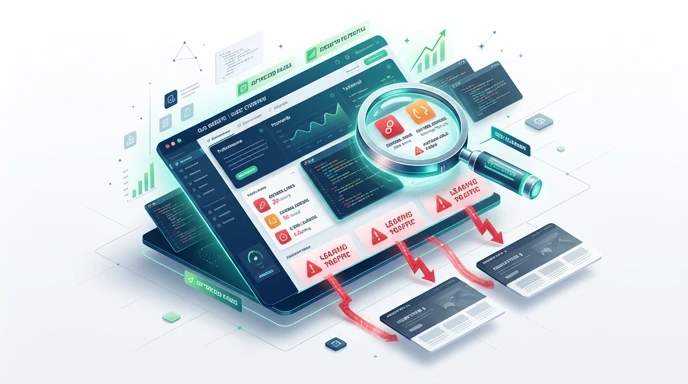
Are you looking to get your website audited properly? We provide a detailed SEO audit service so you can understand what is going wrong and how to correct it. For every potential client of ours, we do a thorough analysis of the website, in fact, even before we prepare the SEO contract.
Professional SEO Audit
We have done over 100+ SEO audits for various business sectors, including ecommerce brands, clinics, hospitals and law firms across Kerala, the GCC, the USA, the UK and other English speaking countries. Every audit helps the client understand the critical hidden issues on their website. There could be several unnoticed problems like canonicals, keyword cannibalization, crawl errors, redirects, spammy backlinks, plagiarized content or even hidden text.
This page is all about how a professional website SEO audit is done, and how we can help you fix the errors on your website by turning our findings into an actionable plan that helps you gain search traffic.
Why should you get your website SEO audited by an SEO professional?
You should know everything about your website's current situation. Why it is not ranking, and how you can fix it. It has to be audited by an SEO professional. An SEO audit gives you detailed reports on your website architecture, keywords, URLs, content quality, on-page, off-page and other technical errors.
If you simply put your URL into a tool, you won't know the specific details, like what is working and what you should avoid. We have to use Google Search Console and tools like Ahrefs and Moz to figure out everything on your site. We also review your website code, understand the crawl errors, and fix JavaScript, images, CSS and so on. This helps Google bots crawl and index your website for better visibility and rankings.
When does your business need a website audit?
Your website's organic traffic is either flat or it has declined.
Your organic traffic is supposed to grow over the years. If it declines or stays flat, you have to get your website audited to check which keywords are ranking, their search volume, how to get the low-hanging keywords to rank #1, or how to prioritize more high transactional intent keywords.
You never had a structured SEO roadmap before your SEO campaigns.
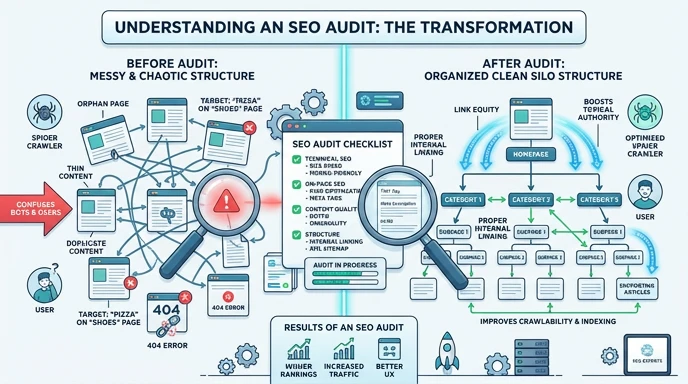
Most businesses, or SEO companies with limited experience, may launch a website and add pages without a proper keyword map, topic clusters, sitemap, internal linking structure or schema markup. You can't simply create pages and blogs without a proper roadmap. An SEO audit helps you create a solid SEO plan.
You want to understand if your current agency is doing their job well.
A comprehensive SEO audit every 3 to 6 months helps you understand whether your current SEO agency is working effectively. You can measure the progress of the ongoing work, the keywords, the organic traffic you get from SEO, how to improve your campaigns, and so on.
You are planning to redesign the current website.
If you are planning to redesign a website that is already ranking, get it audited beforehand so you don't lose the traffic and rankings when you launch the new site. The audit helps you identify and protect your top pages, redirects, canonical pages, backlinks and internal links so you preserve the rankings and traffic.
You are expanding to new locations.
If you are planning to scale across Kerala, India or other countries, our audits help you understand how to scale and expand within your current website setup, and how to rebuild across different locations.
You see technical issues or crawl errors hitting your website frequently.
You might get a notice from Google Search Console saying there are errors preventing your website from being crawled. Or you enter your URL into Screaming Frog, SEMrush, Ahrefs and see a lot of technical errors with a low health score. Or your Google PageSpeed Insights shows a low speed and your site doesn't load fast for your customers. For this, we can get your website audited and give instructions to your dev team on what fixes are needed and how to get them done. Otherwise, we will have it done for you.

What's Included in Our SEO Audit Services
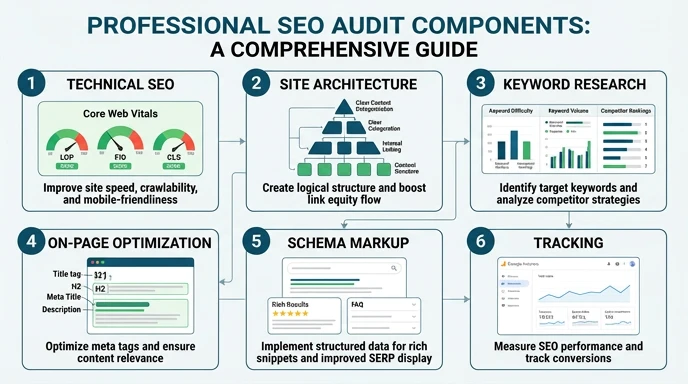
We cover six core areas in every audit. Each one looks at a specific part of your site's SEO health.
01Technical SEO Audit
We crawl your website with Ahrefs Site Audit and Screaming Frog. With the Ahrefs audit, I look at the health score, AI Overviews, ChatGPT pages, the backlink profile (DR and UR), organic keywords, organic traffic, content, and a competitor analysis covering their traffic, keywords, backlink profile, crawl errors and technical issues.
On the technical side, we check speed and Core Web Vitals, 404 pages, 4xx pages, pages linking to broken pages, orphan pages, pages linking to redirects, HTTPS status, 302 and other 3xx redirects, meta descriptions and meta tags, title tags, multiple H1s, word count, duplicate pages without a canonical, the sitemap, noindex tags, CSS files, image files that are too large, missing Open Graph tags, Twitter cards, and structured data validation errors.
Real Example
Elite Infotech came to us recently, and with just a few website fixes a few weeks ago, they started getting traffic. We haven't even done their backlinks yet, there are none. We simply fixed the site through the audit and the content, and it started working.
02Site Architecture & Silo Structure Analysis
Structure matters to SEO because all of this has to be done upfront. We need to know how Google views your website. First we explore the keywords, then the topics. We cluster them and build the sitemap from that. Then we build the internal link structure on top of it, so Google reads the site effectively and so a user on any page can reach the supporting pages and won't miss anything on the website.
We check everything: the grouping, the silos, category to category pages, even blogs linking to category or service pages, and pages with no links. We also create a complete internal linking plan that covers the topics you want to target in future.
Real Example
Luxury Concept connected with us recently and had a bad structure. We built a proper structure for them, and they will start getting enquiries again.
03Keyword & Content Targeting Review
We check what is covered in your content. We use Surfer SEO and Originality.ai to check if it's done properly, without too much AI content, and using real detail. We mostly check at least the first four competitors' content. We look at all the heading tags, H1, H2s, H3s, so that every topic is actually covered.
We flag the keyword gaps, the content gaps, cannibalization, thin content, AI-generated content, the wrong keywords, and whether the search intent of the content matches the keyword intent.
Real Example
I found a lot of cannibalization with one client who had two separate websites optimized for the same keyword. We caught it in the audit and told them. This happens with a lot of websites. We also found content gaps when we compared them against their competitors.
04On-Page Optimization Check
We check the URLs, and whether the slug contains inappropriate characters. We check the headings, H1, H2, H3, whether the headings use and expand the main heading properly and follow the correct hierarchy, whether the primary keyword is in the H1, and whether secondary keywords are used well in the other headings. We look at the structure of the content and whether LSI terms are used properly. We check the keyword placement in the first 200 words, the 200 OK and other HTTP codes, the images, the alt text (whether it's too broad), and the image slug.
We also check that the schema markup is implemented well for local business, organization or service pages. We check the map and locations and all the calls to action, that the phone number, WhatsApp and other forms are working and even implemented at all, that the Open Graph tags are done properly, that the call button and phone numbers on the site are correct, that social media links are added, and whether the GMB profile is linked. Everything is checked against Google's guidelines.
05Schema Markup & Structured Data Audit
Schema markup gives you rich results in search. That's mostly your service pages showing underneath your main page when someone searches for you. For ecommerce sites you can see products with pricing, availability and ratings. You also get recipes, videos (with thumbnail and duration), and events (with time, location and date).
We create the schema based on the page type, whether it's a service page, product, organization, event and so on. We use a schema markup generator to build it and a schema testing tool to validate it, check for errors and fix them.
Real Example
I have seen this go wrong on many websites. People list product, service and even local business schema all on the homepage. People who don't understand schema well end up putting it everywhere. It happens a lot with local SEO agencies in Kerala.
06Tracking & Conversion Setup Verification
Tracking matters because it's what shows whether the monthly SEO activities you're doing are actually giving results. You need to check the improvement in traffic, the backlink profile, and the quality of the backlinks.
We use GA4 to count goals and events: traffic improvement, organic traffic, keywords, new users, leads, calls, form submissions, and GMB profile calls, impressions and messages. For ecommerce we track add to cart, the thank-you page, add item, remove item and so on. This tells us what has to be improved.
Our SEO Audit Process (Step-by-Step)
Every audit runs over about 5 to 7 days. Here's what happens.
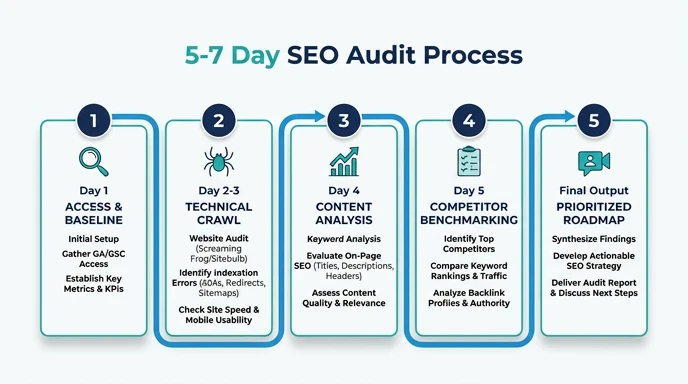
1Access
You give us access to Google Search Console and Google Analytics (GA only if you are already getting traffic).
2Crawl & Technical Check (Day 2)
We crawl the site through Ahrefs and check Search Console for technical errors, crawl errors and backlinks.
3Keywords, Clusters & Sitemap (Day 3)
We find your keywords, your competitors' keywords and the blogs they cover, build the topic clusters, create the sitemap and internal link structure, and cross-check this against your current sitemap.
4Content Review (Day 4)
We check the content and understand the content gaps and structure.
5The Complete Audit Report (Day 5)
We put together the complete audit report of what has to be fixed and how. This is documented, and we also explain it to you in a meeting.
Tools We Use
Tools give us the data, but we read it manually.
Ahrefs
For most errors and to get an overall picture.
Google Search Console
For Core Web Vitals, to see penalties if any, the sitemap, schema markup and other crawl errors.
Surfer SEO and Originality.ai
For content checks.
Moz
On-demand crawl and the on-page grader for page-level audits.
Screaming Frog
For the deeper technical crawl.
Manual HTML review
Alongside Search Console.
Why Choose Techpullers for Your SEO Audit
100+ audits across diverse industries
We've audited law firms, ecommerce brands, interior designers, construction companies, packers and movers, logistics companies, institutions, RV thermostat brands, industrial chemical and equipment companies, construction equipment, CCTV and safety camera brands, home automation companies, ayurveda hospitals, eye hospitals, dental clinics, yoga institutions, tour agencies and business setup companies.
Tools plus human reading, not auto-checklists
Every audit is reviewed by Aiswariya Kolora, so you get what actually needs to be done, not just a report generated by a tool.
Deep experience with Kerala and international markets
We've worked across Kerala and India, the UAE (Dubai, Abu Dhabi, Sharjah), Oman, Kuwait, Qatar, Australia, the US, the UK, Canada and Malaysia.
Your first audit is free
The free audit is a generic version covering the basic things affecting your website. It's crucial information, but it won't include the how-to-fix documents, comprehensive keyword lists and so on.
Google Ads certified
We bring a full-funnel view across SEO and paid. You can check our certification here.
We don't just audit, we implement
We've implemented for 100+ clients and hit a 100 health score through our technical SEO services, on-page SEO services and keyword research services. We have our own developers, and we're easy to communicate with.
One Thing Other Agencies Get Wrong
Honestly, it's usually the basics. Keyword mapping, cannibalization, topic clusters, a solid website sitemap and the internal linking structure. Even the agencies that claim to be the best often get these wrong.
After the Audit — Implementation Options
After the audit, you have three ways forward.
Option 1: Do it yourself
You take our roadmap and handle the fixes, or forward it to your own SEO or dev team.
Option 2: We do everything
We have developers and SEOs to get it all done for you.
Option 3: Hybrid
We handle the topic clusters, keywords, internal link structure and the technical work, and your writer handles the writing.

Frequently Asked Questions
An SEO audit takes a week. If you just want a free audit to know what went wrong, we'll give you that in 3 days. For the comprehensive audit with how-to-fixes, you'll need to wait about a week.
It costs around ₹5,000 to ₹10,000 for a comprehensive SEO audit with a complete one-year SEO roadmap. It also depends on the size of the website. You can see our full SEO pricing here.
We can audit sites of all sizes, though the pricing may vary.
That's not a problem. You can hand over the audit report with the fixes and roadmap for them to follow.
Yes, we can. We audit the competitor's site and check the gaps against yours, so you can build a plan to beat them in search.
If the site is fixable, we'll do it for you. Otherwise we'll give you the plan. We cross-check all the issues, and if you want us to fix it, we will. The fix can take time to show up. Sometimes it's a few weeks, depending on the penalty.
If you have an SEO agency working for you, get it audited every month. Otherwise, if you have major issues, do it immediately. Take our help if you aren't seeing rankings, or you're frustrated with flat or declining traffic.
Yes, we can. We're an SEO agency in Kerala backed by a development, content and SEO team. Our main SEO person is our CEO herself, Aiswariya Kolora. She is the one who figures out the problems on your site and audits it herself.
If it's already on a server, yes, we can. Otherwise we can check the keywords, competitors, sitemap and internal links, and how to get started.
Just the basics: what went wrong on your site and the technical errors.

About the Author
Aiswariya Kolora is the CEO of Techpullers. She has 13+ years of experience in SEO and digital marketing. She creates the roadmap, strategies and methodologies for SEO at Techpullers. We've been winning in search since 2019 because of her efforts and her continuous dedication to learning new concepts and adapting accordingly.
Ready to Audit Your Website?
Start with a free audit and find out what went wrong on your site. No commitment. If you'd rather go straight to the full audit and a complete roadmap, book a call with our team.
Get Your Free Website Audit