Google's February 2026 Discover Core Update
What Changed (And How To Win Discover Traffic Without Clickbait)
If you've ever had Google Discover send you a wild spike of traffic—then disappear the next day like nothing happened—welcome to the club.
We see this pattern constantly while running SEO services for brands that depend on content-led growth.
Discover is the most emotional traffic source on the internet:
It can give you thousands of visits in hours.
It can also drop you to zero with no warning.
And unlike Search, you're not "ranking" for a keyword—you're being recommended in a feed.
On February 5th, 2026, Google officially announced a Discover core update. And the wording was…
classic Google: broad, polite, slightly cryptic.
But inside that "cryptic" language is a very clear direction.
What Google Officially Said (The Only Part We Can Trust 100%)
Google says the February 2026 Discover core update improves Discover in three key ways:
More locally relevant content from websites based in a user's country
Less sensational content and clickbait
More in-depth, original, and timely content from sites that show expertise in a given area
Google also confirmed two important things most people miss:
Discover traffic will fluctuate as a result of this update.
The rollout started with English users in the US, then expands to more countries and languages.
So yes—if you're outside the US, you might not see the full impact immediately. But the direction is set.
Why This Update Matters (Especially If You're a Publisher or Content-Led Business)
Discover has had a long-standing quality problem. If you open Discover in India (or anywhere, honestly),
you'll often see celebrity gossip, sensational headlines that overpromise, "shocking" hooks, and thin posts pushed by aggressive thumbnails.
And in many cases, users get a bad experience after clicking:
The page loads slowly
A redirect happens
The back button doesn't behave like it should
The article is padded, misleading, or just plain fake
Google didn't name every trick, but they did say they're reducing "sensational content and clickbait."
That's not a small statement.
The Hidden Message: "Discover Is Becoming Stricter, Not Smarter"
This update isn't telling you to "do SEO." It's telling you to stop playing games and start behaving like a real publisher:
Write like someone who knows the topic.
Don't bait clicks you can't satisfy.
Build topical depth so Google can classify your expertise.
Give users a clean, fast reading experience.
Because Discover is basically a trust engine.
And in 2026, trust is what Google is trying to protect—especially as search becomes "everywhere" (feeds, AI answers, apps, voice).
If you're building for that shift, read our framework on
Search Everywhere Optimization.
1) "More Locally Relevant Content" = Local Sites Finally Get a Real Shot
Google says they want to show users more content from sites in their country.
This matters because many Discover feeds (especially in India) often look "global-first" even when the user clearly wants local context.
What this likely means in practice:
Indian users should see more Indian publishers
Kerala users should see more Kerala stories (if the site is strong)
Regional experts can compete better—if they build authority
Important: This doesn't mean "small sites will automatically win." It means local sites have more opportunity—but only if the quality and expertise signals are strong.
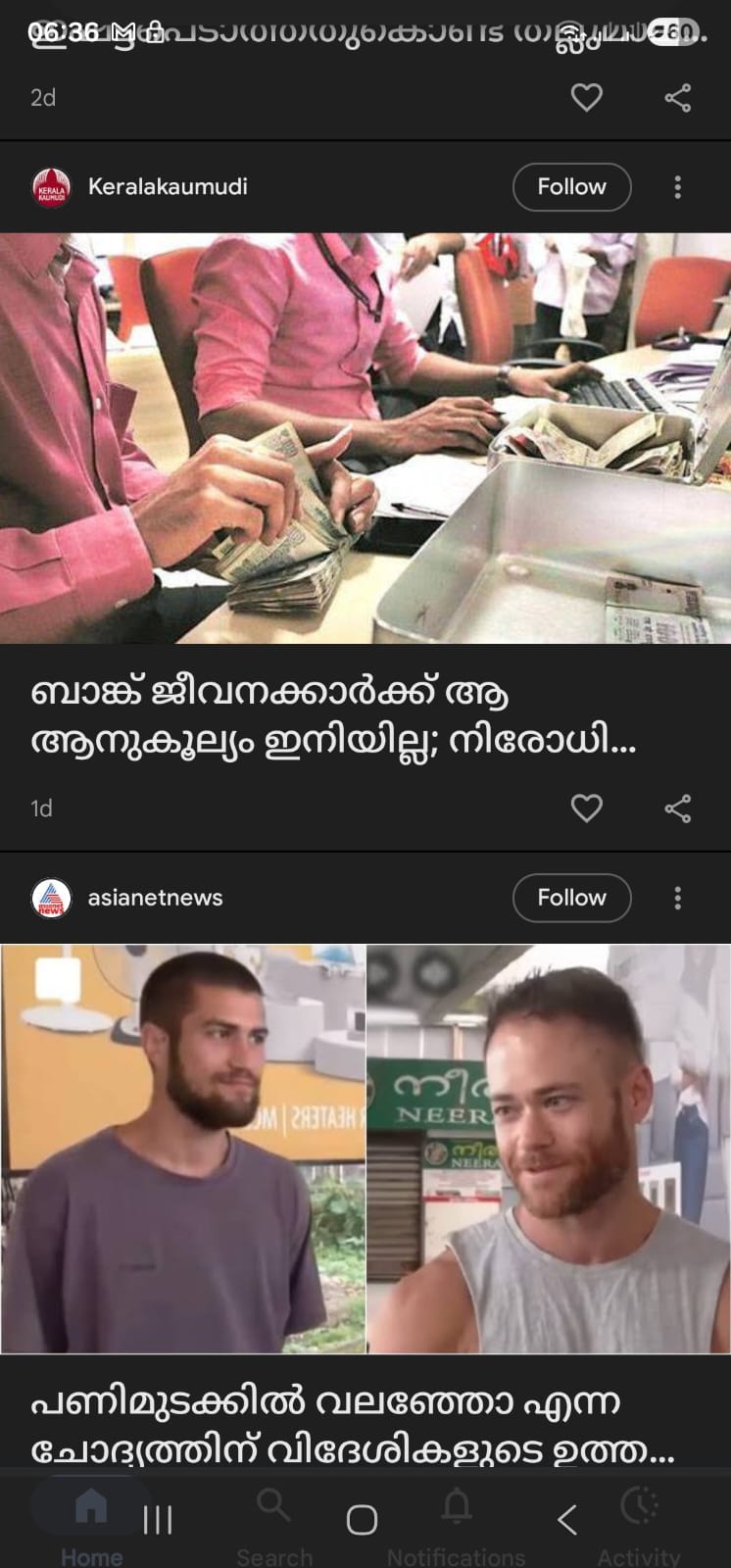
Discover feed example from Kerala (mobile).
2) "Less Clickbait" = Sensational Thumbnails and Misleading Titles Will Get Punished
Google explicitly says they're reducing sensational content and clickbait.
So if your Discover strategy has been exaggerated titles, half-truth hooks, "you won't believe…" lines,
or content that doesn't deliver on the promise—this update is designed to shrink your reach.
Even worse: when users feel tricked, they bounce fast, they don't return, they hide your content,
and your Discover trust signal collapses.
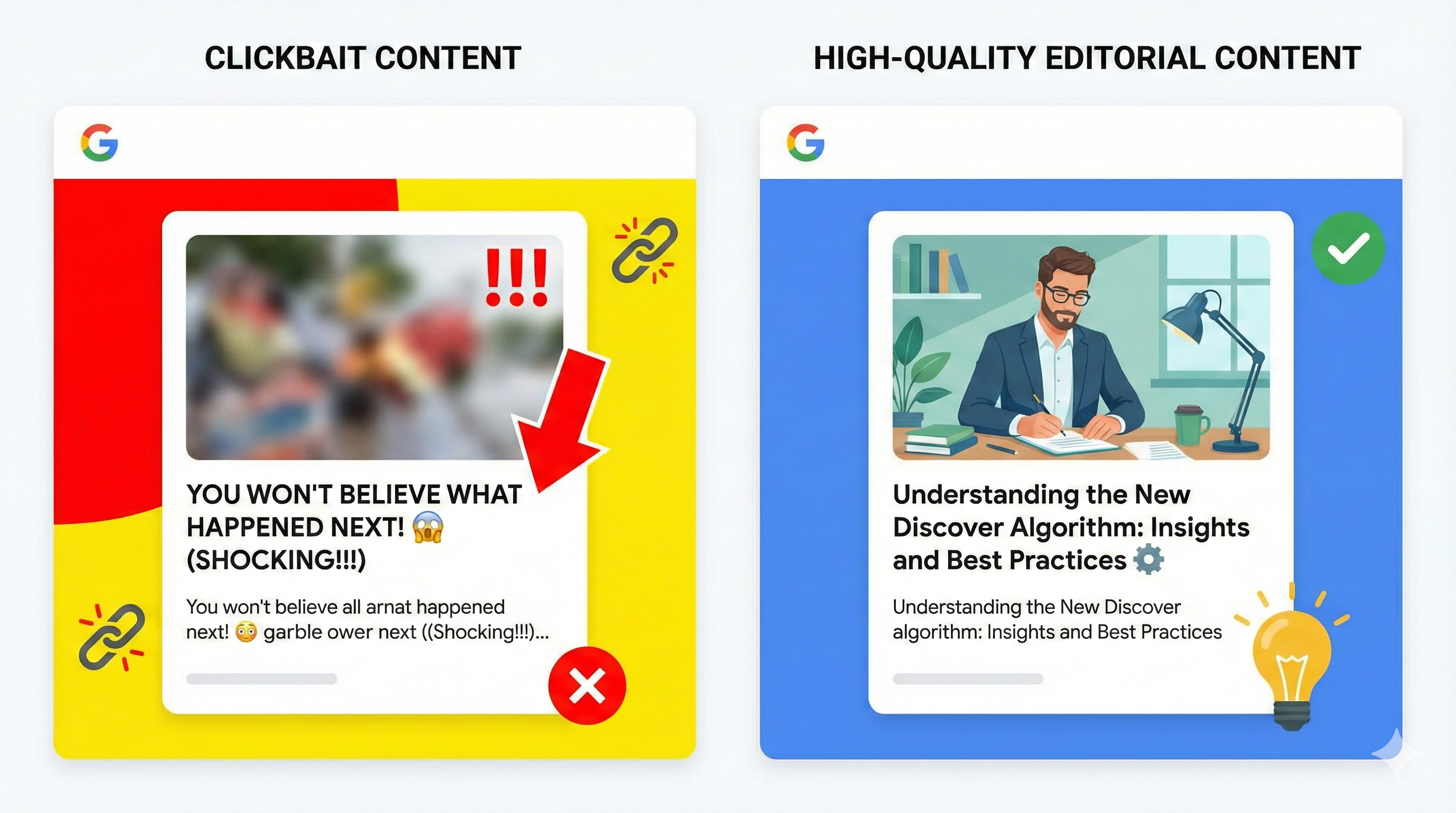
Discover is brutally behavioral. You don't just need clicks. You need satisfaction.
Clickbait vs real editorial quality
3) "More Original + Timely + Expertise" = Topical Authority Beats Random Publishing
This is the most important part of the update.
Google says they'll show more in-depth, original, timely content from websites with expertise in an area—based on their understanding of the site's content.
They even gave a simple example:
A local news site could still be considered an expert in gardening if it has a dedicated gardening section, even if it covers many topics overall.
Translation:
Random-topic sites will struggle. If you publish finance today, cinema tomorrow, astrology next, then a tech tutorial… Google can't confidently label what you're "good at."
Focused sites will win. If you consistently publish strong content in one area, Google can model your expertise—and recommend you more.
This is bad news for "everything websites." And good news for specialists.
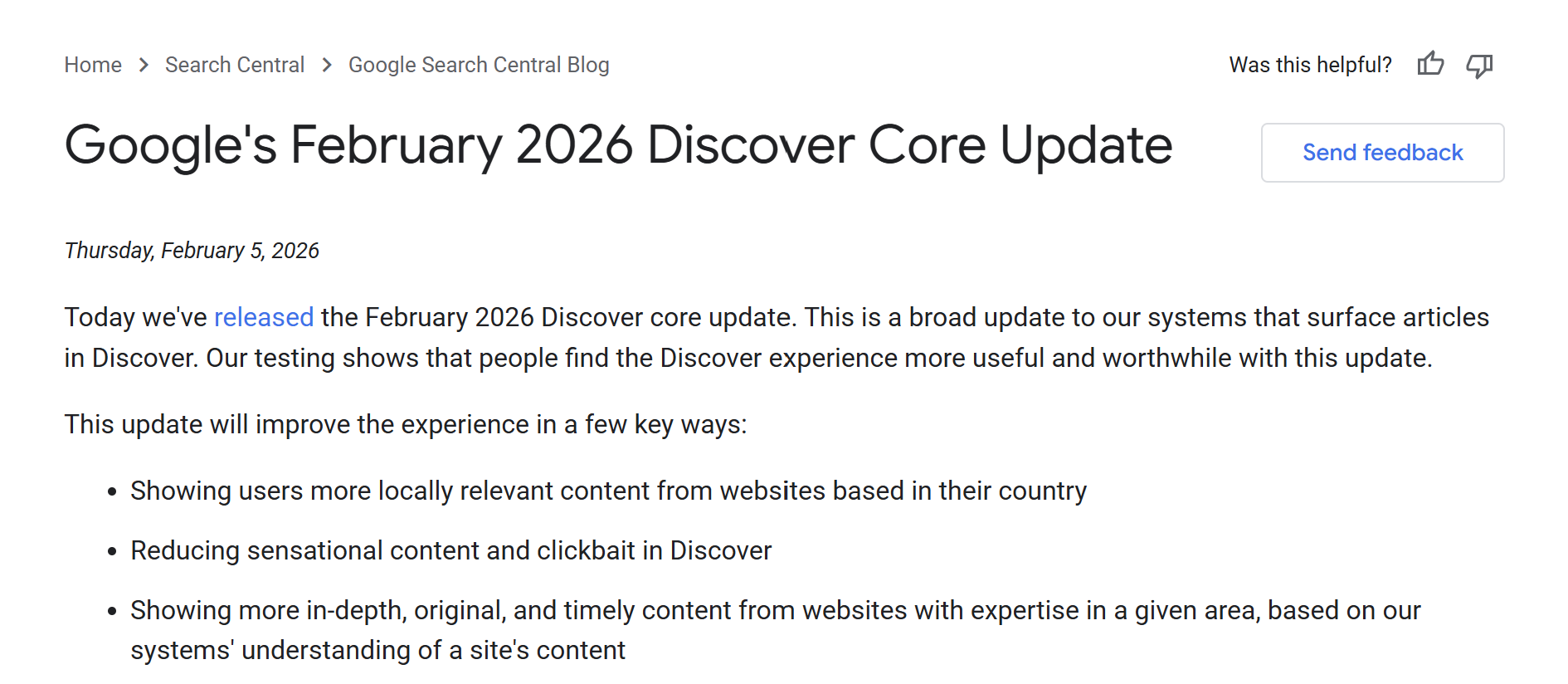
Google's official announcement screenshot.
What You Should Do Next (A Practical Checklist That Actually Helps)
Google's Discover documentation has been clear for a while: you need timely content, strong images, and a great page experience.
Now that the update is explicitly pushing those signals, here's the playbook.
Step 1: Fix the "Back Button Trap" and Any Sketchy Redirect Behavior
If your page:
Redirects after click
Opens interstitials that hijack navigation
Changes URL states strangely
Dumps users on the homepage when they hit back
Action items:
Remove doorway pages
Reduce redirect chains
Keep the article URL stable
Avoid aggressive "open in app" takeovers
Ensure back button returns the user to where they came from
Step 2: Choose 1–2 Topics You Want Discover to Know You For
Decide:
What are we actually expert in?
What can we publish on weekly without fluff?
What does our audience already trust us for?
If you publish everything, Google will trust you for nothing.
Then build a simple structure:
1 pillar page (the topic hub)
6–12 supporting articles
Internal links between them
Consistent publishing cadence
Step 3: Upgrade Your Titles (Keep Them Interesting, Not Manipulative)
A good Discover title is specific, clear, emotionally interesting—but still honest.
Bad: "This Kerala Business Did Something Shocking…"
Better: "Kerala Businesses Are Losing Discover Traffic—Here's What Google Changed in Feb 2026"
Step 4: Images: Stop Treating Them Like Decoration
Step 5: Page Speed + Stability (2–3 Seconds Is a Good Real-World Target)
Quick wins:
Reduce ad/script weight
Lazy-load below-the-fold media
Fix CLS (layout shift)
Use caching + CDN properly
Step 6: Publish Regularly (But Only Within Your Expertise)
It means:
Publish consistently in your niche
Update older posts when there's new context
Build a predictable "signal" that your site is active and valuable
If You're a Kerala/India Publisher: Why This Could Be Your Biggest Opportunity in Years
If Discover truly becomes more local-first, that's a massive shift for regional publishers, Malayalam/English hybrid sites,
niche local businesses producing original content, and subject experts (finance, health, travel, education, tech).
But the sites that win will be the ones that look like real brands, not traffic farms:
Clear editorial identity
Author info
Consistent topic focus
Strong UX
Fewer gimmicks
For Kerala businesses looking to strengthen their local SEO presence alongside Discover optimization, explore our Local SEO services.
What NOT to Do (This Will Get Worse After This Update)
Don't buy expired domains and publish random trending posts
Don't spin content across 50 topics and hope one hits
Don't use clickbait titles that don't match the article
Don't hijack navigation with doorway pages or redirects
Don't upload low-quality blurred images and expect Discover love
How Long Until the Dust Settles?
Google calls it a "core update" for Discover, so volatility is normal. In practical terms:
Expect turbulence for a few weeks
If you make changes today, measure impact over 2–6 weeks
Don't panic-edit 20 things at once—change, observe, iterate
Also remember: rollout began with English users in the US first. So global impact may stagger.
FAQ
No—this announcement is about how content is surfaced in Discover. But better content and page experience can support overall organic performance.
Yes. If your website shows clear expertise and publishes original, timely content in a focused topic area, you can earn Discover visibility.
Not necessarily. Large image previews can be enabled using max-image-preview:large. AMP is optional.
Fix clickbait titles, upgrade feature images to 1200px+, and improve page speed and stability.
Final Take: Discover Is Turning Into a "Publisher Quality Filter"
If you've been frustrated with Discover, you're not alone.
But this update is Google admitting something important: they want Discover to feel more useful, less spammy, and more trustworthy.
So the strategy is simple (not easy):
Be local where it matters
Be original where it counts
Be honest in what you promise
Be fast in what you deliver
If you need help navigating these changes and optimizing your content strategy for Discover and Search, reach out to our team at Techpullers.
Aiswariya Kolora is a professional digital marketing strategist and SEO expert. As the founder of Techpullers, she crafts effective online marketing strategies that help businesses grow.
Follow on:
Leave a Comment
Your email address will not be published. Required fields are marked *
Thank you! Your comment has been submitted and is awaiting moderation.
Be the First to Comment
No comments yet. Be the first to share your thoughts!
Grow your BUSINESS with Quality Search Engine Optimization
Leave a Comment
Your email address will not be published. Required fields are marked *