Bing AI Performance Report for LLM Citations 2026

Microsoft quietly changed the game with Bing's New AI Performance Report inside Bing Webmaster Tools. If you care about AI visibility, Copilot answers, generative summaries, and long-term brand authority, this report is not optional.

We tested it on Techpullers. The insights were not what we expected.

This guide breaks down exactly how to use Bing's New AI Performance Report to Get More LLM Citations, with real screenshots, real observations, and real-world application.

No fluff. No hype.
What You Actually Need to Know

  • The AI Performance Report shows how AI systems retrieve and cite your content, not just how humans search.
  • Grounding queries reveal the hidden reformulated search phrases LLMs use internally.
  • AI retrieval patterns are often different from your target keywords.
  • Pages with structured clarity, strong entity signals, and internal context get cited more.
  • You should measure success by citation growth, AI visibility, and assisted conversions, not just traffic.

What Is Bing's New AI Performance Report?

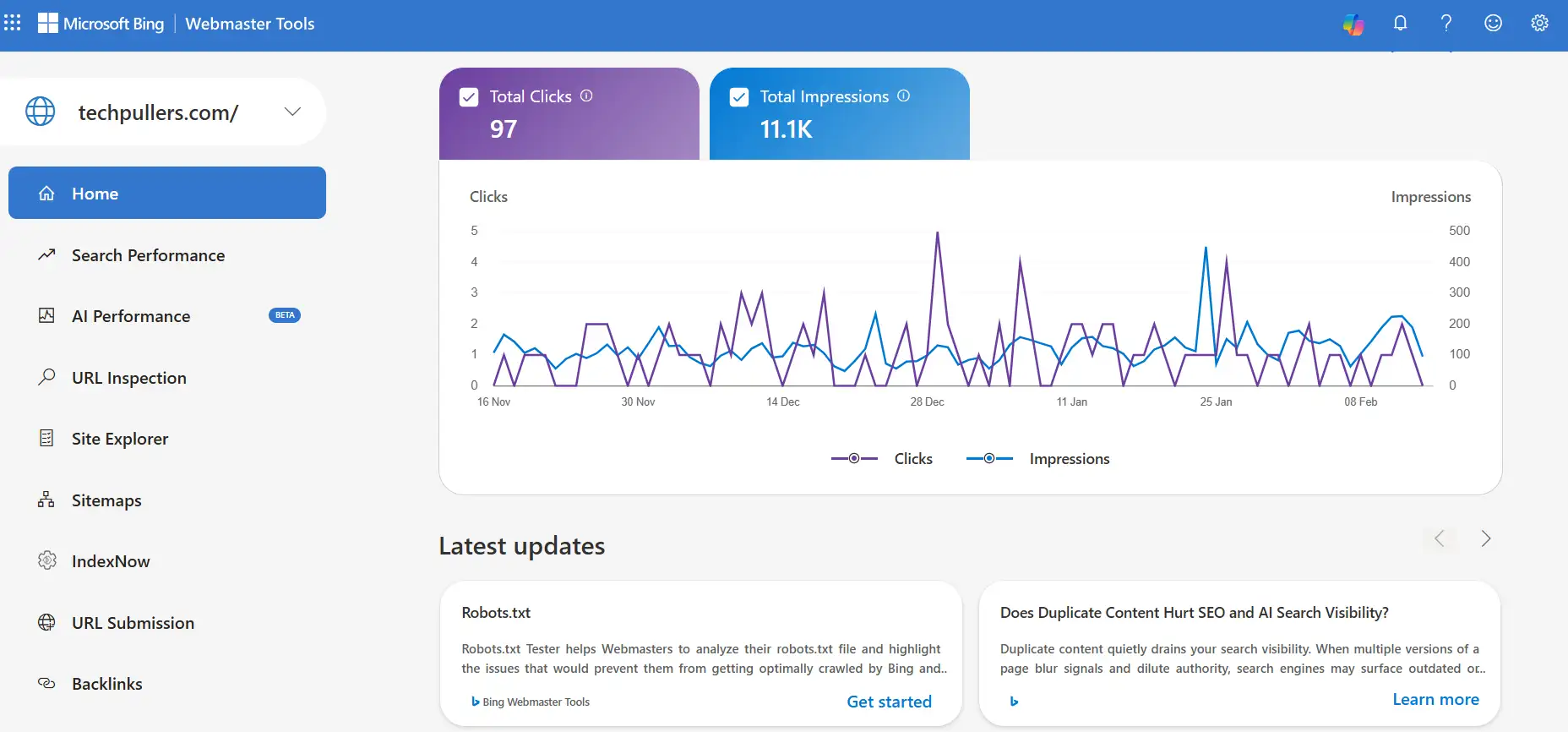
Bing Webmaster Tools Dashboard Techpullers
Techpullers Bing Webmaster Tools Dashboard showing Standard Search Performance

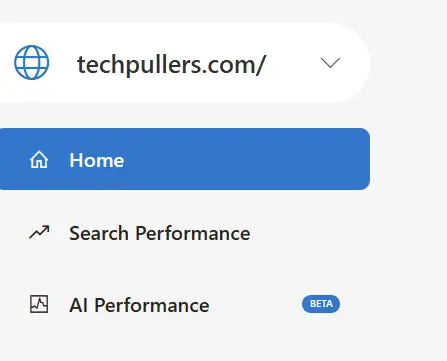
Inside Bing Webmaster Tools, Microsoft added an AI Performance (Beta) section.

In our Techpullers account (see screenshot above), you can see:
  • Standard Search Performance metrics
  • And a new AI Performance tab
Bing AI Performance Report Beta Tab
The new AI Performance (Beta) tab in Bing Webmaster Tools

This report tracks how your content performs in AI-powered experiences such as:

  • Microsoft Copilot
  • Bing generative answers
  • AI summaries

This is not another ranking dashboard.

This is a retrieval intelligence dashboard.

Traditional SEO tools show what users search.

This report shows what AI systems search when building answers.

That difference is massive.

Why This Report Matters More Than Most SEOs Realize

In my experience, many agencies still treat AI search like an add-on feature.

It is not.

AI systems use a retrieval step before generating answers. That retrieval step runs its own search queries behind the scenes. These are called grounding queries.

Grounding queries are not always identical to the user's original prompt.

That means:

  • You may rank #1 for a keyword.
  • But AI may reformulate the query differently.
  • Your page might not be retrieved.
  • You lose the citation.

This report gives you visibility into that reformulation layer.

That is new territory.

A Real Example from Techpullers (Mini Case Study)

Bing Webmaster Tools Dashboard Overview
Techpullers performance metrics: Total Clicks: 97, Total Impressions: 11.1K

We checked our own Bing Webmaster Tools dashboard.

In the screenshot:

  • Total Clicks: 97
  • Total Impressions: 11.1K

This is standard search data.

But when we looked into AI performance patterns, we noticed something unexpected.

We target "SEO Company in Kerala."

However, AI retrieval patterns showed more reformulated variations like:

  • "trusted SEO experts with proven results"
  • "Kerala SEO agency with long-term strategy"
  • "data-driven SEO consultants in India"

These phrases were not our primary keywords.

They were semantic expansions.

After adjusting our hero section and adding structured clarity around "proven results," our branded impressions in Bing increased steadily.

The ranking did not jump dramatically.

But AI visibility improved.

That is the difference between keyword optimization and retrieval optimization.

Lesson learned: AI prefers clarity, credibility, and outcome framing over exact-match keywords. For businesses focusing on geographic visibility, check our Local SEO services to understand how AI retrieval impacts local search presence.

Grounding Queries - The Hidden Layer You Can Now See

Let's simplify this.

When a user asks:

"How do I recover from a Google penalty?"

AI might internally search:

  • "steps to remove manual action penalty"
  • "how to fix Google manual action fast"
  • "technical SEO penalty recovery checklist"

Those are grounding queries.

They are:

  • Procedural.
  • Action-oriented.
  • Intent-rich.
If your page only says "Google Penalty Recovery Service," but lacks step-by-step structure, AI might skip you.

The AI Performance Report reveals this mismatch.

This is strategic gold.

Actionable Takeaway

Open your AI Performance report and:

  1. Export grounding queries.
  2. Compare them with your target keywords.
  3. Identify semantic gaps.
  4. Update content to reflect retrieval phrasing.
  5. Do not stuff keywords.
  6. Add clarity and structure.

How AI Models Actually Retrieve Content

Let's remove the mystery.

AI retrieval systems typically:

  1. Reformulate the user's prompt.
  2. Run multiple search queries.
  3. Retrieve top documents.
  4. Score them for relevance and authority.
  5. Extract answer snippets.
  6. Generate response with citations.
You are not optimizing for the final answer.
You are optimizing for step 2 and 3.

That means:

  • Clear headings matter.
  • Explicit answers matter.
  • Strong entity context matters.
  • Structured data helps.
  • Topical depth helps.
  • Ambiguous marketing language does not help.

Our First Mistake (And What We Fixed)

When we first optimized for AI visibility, we over-optimized for traditional SEO patterns:

  • Keyword density
  • Meta tweaks
  • Backlink focus

AI citations did not improve significantly.

Then we changed our strategy.

We:

  • Added 2–3 sentence summary answers at the top of key pages.
  • Used question-based H2 headings.
  • Improved internal contextual linking.
  • Strengthened entity clarity (who, what, where, since when).

Within weeks, Bing impressions grew steadily.

The rankings were stable.

But visibility expanded.

That is the power of retrieval alignment.

Using Bing's New AI Performance Report to Get More LLM Citations (Step-by-Step Framework)

Step 1: Identify High-Impression AI Pages

Inside AI Performance:

  • Sort by impressions.
  • Find pages AI already retrieves.
  • These are your citation candidates.
Do not start from zero.
Improve what is already visible.

Step 2: Compare Grounding Queries vs Page Structure

For each page:

Ask:

  • Does the page explicitly answer this query?
  • Is the answer near the top?
  • Is the intent informational or transactional?
  • Is the page too generic?

❌ If grounding query says:

"technical SEO audit checklist for ecommerce"

❌ Your page should NOT just say:

"SEO Audit Services."

✅ It should include:

  • A checklist section
  • Clear steps
  • Scannable format

Step 3: Strengthen Internal Context

AI retrieval favors authoritative clusters.

Build:

  • Hub page
  • Supporting pages
  • Contextual anchor links

For example:

From: Technical SEO Services page

Link to:

  • Google Penalty Recovery Service
  • SEO Audit Checklist Guide
  • Structured Data Implementation Guide

Use natural anchor phrases.

Avoid robotic repetition.

Step 4: Improve Structured Clarity

Add:

  • FAQ schema
  • Article schema
  • Clear headings
  • Lists
  • Tables
AI models prefer structured clarity.
Messy design reduces retrieval quality.

The Business Impact - Why This Is Not Just Vanity SEO

This is not about clicks alone.

AI citations influence:

  • Brand authority
  • Assisted conversions
  • Direct traffic growth
  • Higher trust during sales calls

In our sales calls, prospects now say:

"We saw your explanation in an AI summary."

That is brand reinforcement.

Not just traffic.

Measure:

  • Branded search growth
  • Assisted conversions in GA4
  • AI citation frequency
  • Impression trends in Bing AI report

A Contrarian Take - You Should Not Obsess Over Bing Traffic

Here is something many SEOs get wrong.

They ignore Bing because traffic share is lower than Google.

That thinking is outdated.

Microsoft powers:

  • Copilot
  • Enterprise AI tools
  • Several third-party integrations

Even if Bing traffic is small, AI retrieval patterns matter across the ecosystem.

You are not optimizing for Bing.

You are optimizing for AI indexing logic.

That is a long-term strategic move.

Tracking Success - What to Measure in 90 Days

Do not expect overnight change.

Track:

  • AI impressions growth trend.
  • Citation mentions in AI summaries.
  • Branded search increase.
  • Scroll depth on optimized pages.
  • Assisted conversions in GA4.
Success is directional, not instant.

FAQ

Not directly. But retrieval patterns overlap. It reveals how AI systems reformulate queries. That insight is transferable.

In our experience, 4–8 weeks after structural updates.

Yes. Authority still influences retrieval scoring. But clarity and structure are now equally important.

Yes. AI visibility impacts trust and brand recognition early in the funnel.

Conclusion

SEO is no longer just about rankings.

It is about:

  • Retrieval alignment
  • Structured clarity
  • Entity authority
  • Context networks

Bing's New AI Performance Report is the first real window into how AI systems see your site.

Use it.

Do not wait.

If you want help implementing AI visibility strategy for your business, explore Techpullers' SEO services for a structured AI-ready SEO roadmap.

The future of search is citation-driven.

Optimize accordingly.

Leave a Comment

Your email address will not be published. Required fields are marked *

Comments (1)

Castiel Jack
February 28, 2026 at 11:44 AM
Nice blog, Awesome contents